



Mother’s Day is one of those occasions where thoughtful emails really pay off. It’s a chance to connect with your audience, make your campaigns feel personal, and inspire action without feeling pushy.
At the same time, not everyone celebrates Mother’s Day, so your messaging needs to be considerate and inclusive.
In this guide, you’ll find five practical email ideas, along with tips on timing, personalization, and creative ways to drive engagement so your campaigns feel smart, human, and memorable.
When is Mother’s Day? (Plan your send schedule)
Mother’s Day falls on different dates around the world (and changes every year too) so it’s important to know your audience when planning your email campaigns:
- United States: Sunday, May 10th 2026
- United Kingdom & Ireland: Sunday, March 15th 2026
- Australia & New Zealand: Sunday, May 10th 2026
- Other regions: Dates vary here, so it’s best to check local calendars
Mother’s Day campaign calendar
A week-by-week timeline can help you map out your emails and promotions effectively. Here’s what that might look like:
- 4-6 weeks before: Start brainstorming offers, creative ideas, and content
- 3-4 weeks before: Prepare email assets, landing pages, and segmentation
- 2 weeks before: Launch teaser emails to build anticipation
- 1 week before: Send main campaign email with key offers
- 2-3 days before: Last chance reminder or limited-time offers
Planning ahead
Most marketers start planning 6-8 weeks in advance. This gives you enough time to test things like subject lines, refine segments, and align your cross-channel messaging without rushing at the last minute.
Mother’s Day is part of a bigger trend in seasonal spending
Holiday seasons are seeing steady growth in consumer spend, and Mother’s Day plays into that too.
According to the latest holiday shopping insights, total consumer spend increased from $241.1 billion in 2024 to $257.8 billion in 2025. That tells us people are still willing to buy for meaningful occasions and emails that make the decision easier can tap into that behavior.
People are actively looking for thoughtful ideas and timely offers during these moments. When you match that mindset with relevant content, you’re more likely to connect and convert.
Know your audience before you click send
The key to a successful Mother’s Day campaign is understanding who you’re talking to and what matters to them. Segmenting your list helps your emails feel relevant and personal.
Here’s how to segment your email list:
- Gift-givers vs. mothers: Tailor your messaging depending on whether someone is buying a gift or receiving one. Gift-givers might appreciate product guides, special offers, or delivery reminders. People may prefer content focused on celebration ideas or self-care.
Set up a preference centre
Some recipients may prefer not to engage with Mother’s Day. In this case, a preference centre lets subscribers choose the type of content they receive. You can offer options like:
- Only receive gift guides or promotions
- Skip Mother’s Day emails entirely
- Opt-in for reminders about other seasonal campaigns
Giving your audience control reduces the risk of unsubscribes and helps your messages land in the right inbox at the right time. You can see a further example below.
Mother’s Day email marketing examples
1. Showcase personalized gift recommendations
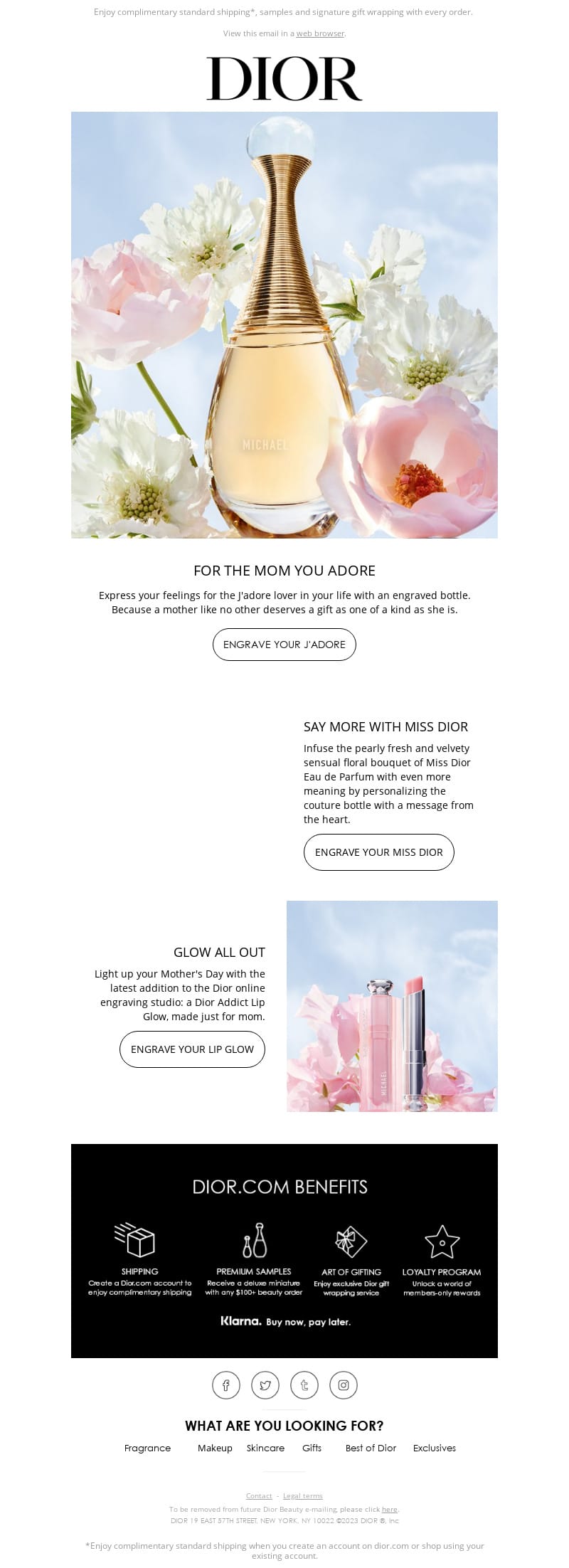
Mother’s Day is a great moment to promote gifts that feel thoughtful and personal. Even small custom touches, like monograms or engraved messages, can increase perceived value and drive conversions.
If you offer personalization, make it easy to find and simple to use. Call it out clearly in your email and show examples of what customers can create.
A good example of this comes from Dior, which promotes bespoke engraving across its product range for Mother’s Day. The brand also supports the purchase with complimentary shipping, samples, and premium gift wrapping. These details can help remove friction and make the buying experience feel seamless from start to finish.
How to apply this to your campaign:
- Highlight personalization in your subject line or hero banner
- Show a real example of a customized product
- Reassure shoppers with clear delivery timelines
- Promote value-adds like gift wrap or free shipping
This approach tends to work well for last-minute shoppers and early planners. It gives people a way to send something that feels meaningful without adding complexity to people’s buying journey.
2. Respect your audience while sending seasonal emails
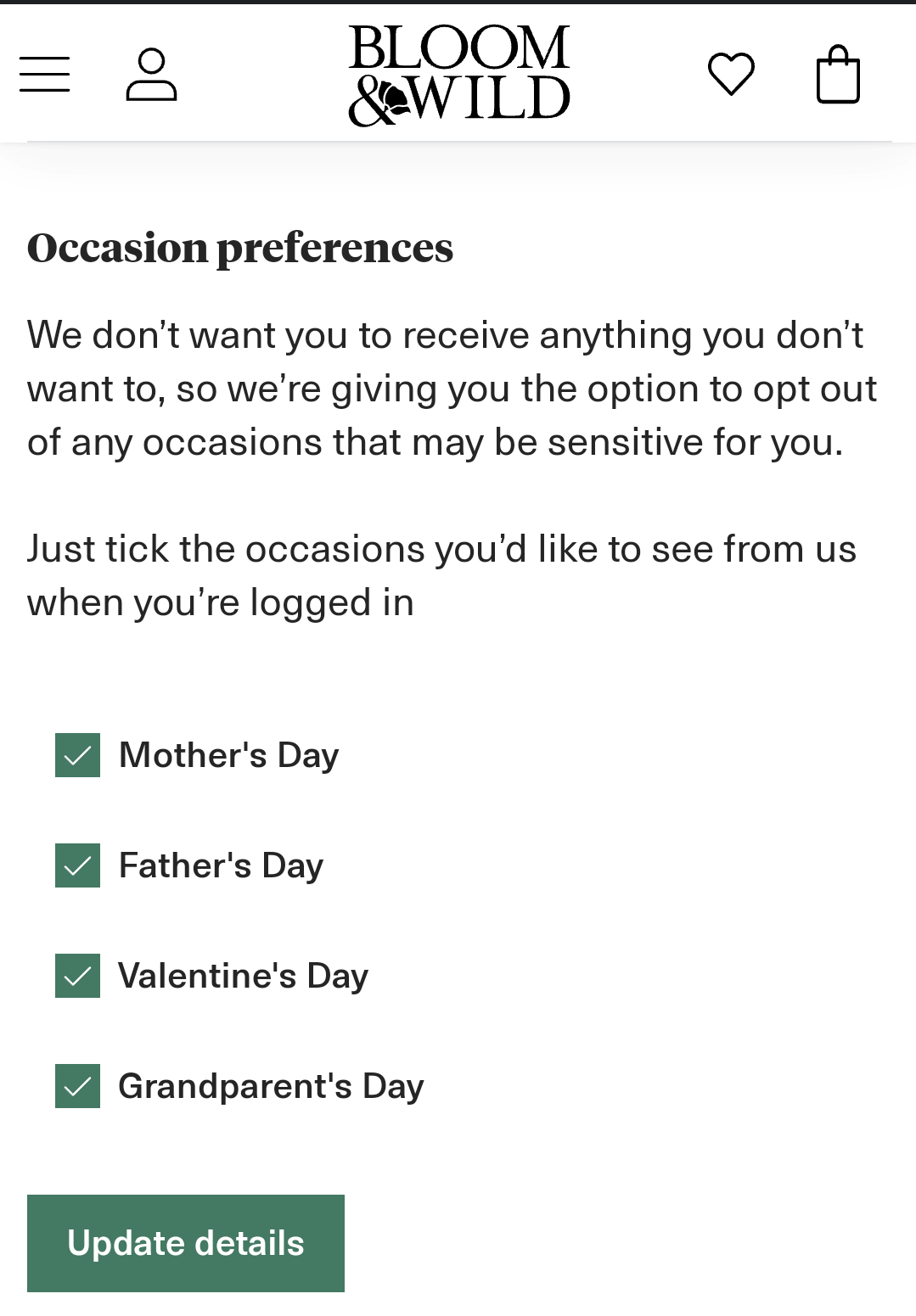
While examples and ideas can inspire your Mother’s Day campaigns, it’s just as important to consider your audience and how often you’ll reach them. For instance, not everyone celebrates Mother’s Day, and it can be an upsetting time for some people. Your messaging around the occasion should be thoughtful and sensitive, and actually, opt-out campaigns aren’t necessarily the answer.
If you are going to be sending lots of campaigns for Mother’s Day, you can give subscribers control over what they receive without sending a separate, standalone opt-out email.
Before considering an opt-out campaign, ask yourself how many emails you plan to send. If it’s just one, a separate opt-out message may be unnecessary. Opt-out options are most useful when subscribers are likely to receive multiple emails about the occasion in a short period.
A better approach is to use your existing preference center and then make use of segmentation tools to let subscribers tailor their experience. This way, you show care, avoid asking your audience for extra emotional labor, and keep engagement healthy.
Tips for thoughtful and inclusive campaigns:
- Have an understanding that the day will look different to everyone, so make sure your content is sensitive and inclusive
- Highlight the option to opt out of any sensitive occasions in one go in your preference center
- Use inclusive language such as ‘for the moms, step-moms, mother figures, and anybody you want to celebrate
3. Create a gift guide that makes buying easy
A gift guide helps your customers decide faster. Instead of scrolling through your entire catalog, they get a shortlist built for the occasion that reduces friction and makes the purchase feel effortless.
You can start by grouping products in a way that makes sense for your audience. You might organize by:
- Price point, such as “Under $25” or “Luxury picks”
- Interests, like food, fashion, or self-care
- Recipient type, such as new moms or grandmothers
In your email, you can position the guide as a shortcut. Use a strong headline, clear category buttons, and concise product descriptions. Keep the layout clean and mobile-friendly so readers can scan and tap without thinking.
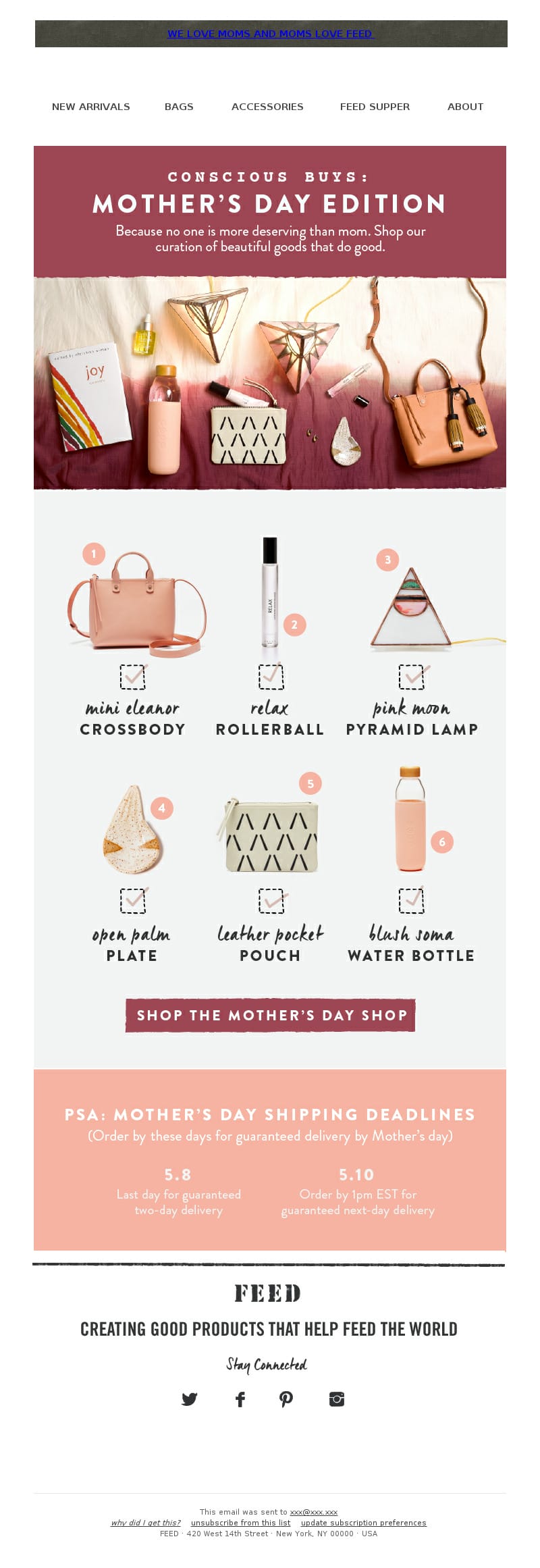
FEED Projects provides a good example of this. In its Mother’s Day campaign, the brand grouped products into a dedicated Mother’s Day shop, catering to different budgets and preferences. By narrowing the options and presenting them clearly, it made the decision process smoother for shoppers.
How to strengthen your gift guide email:
- Lead with a clear benefit, such as “Find the perfect gift in minutes”
- Limit the number of featured products to avoid overwhelm
- Add clear CTAs for each category
- Reinforce delivery deadlines to drive action
4. Bring your cause to life
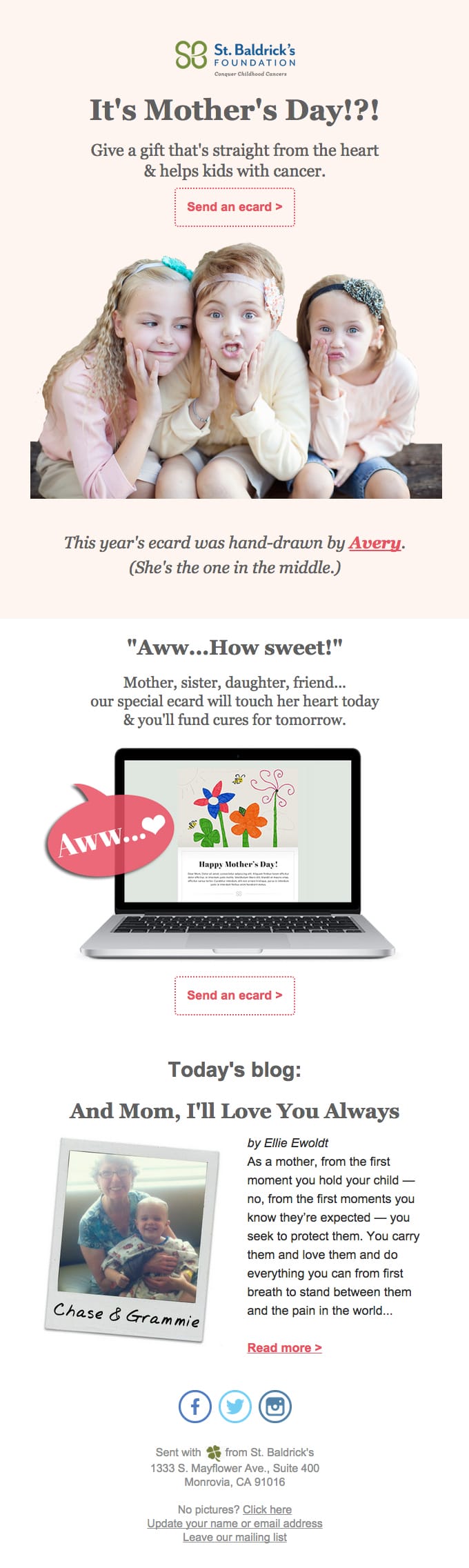
Mother’s Day is a great opportunity for non-profit organizations to spread awareness about their cause and engage their audience in a meaningful way.
Instead of focusing on products, you might:
- Share a story that reflects your mission
- Invite supporters to take a simple action
- Encourage donations in honor of a mother or caregiver
- Create a digital gesture, like sending a message of support
St. Baldrick’s Foundation do this well. It’s a small action but it reinforces the mission and gives people a meaningful way to participate.
How to apply this approach:
- Keep the message clear and emotionally grounded
- Focus on one primary action
- Show the real-world impact of participation
- Make it easy to share with others
When done well, a mission-led Mother’s Day email deepens engagement and reminds supporters why they care about your cause in the first place.
5. Drive sales with interactive offers and engaging giveaways
If you want to stand out in a busy inbox, add an interactive element to your Mother’s Day campaign.
You could try:
- A spin-to-win discount
- A limited-time mystery offer
- A giveaway tied to a purchase
- A social entry contest that drives sharing
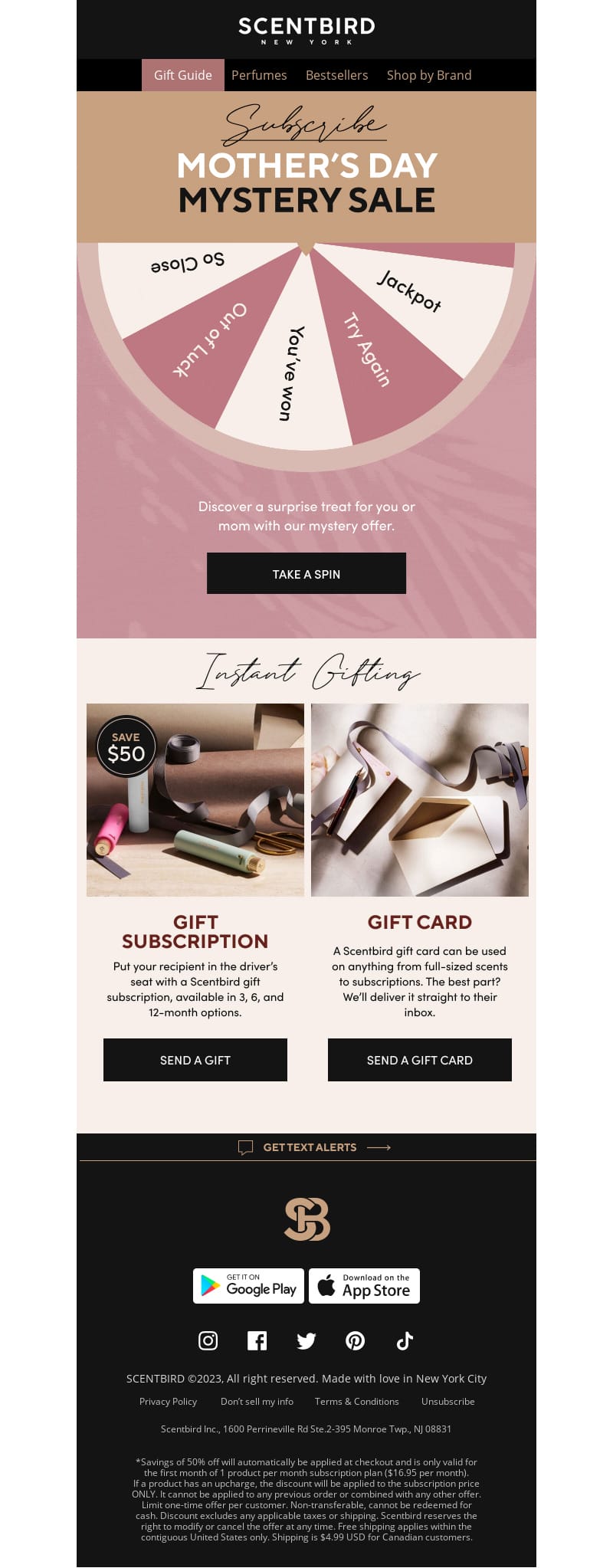
Scentbird ran a “Mother’s Day mystery sale” featuring a spinning wheel that revealed surprise offers. The interactive element added anticipation and encouraged immediate action from people.
How to apply this approach:
- Keep it simple and easy to understand
- Tie the reward to a clear next step, such as shopping or subscribing
- Add a deadline to encourage action
- Make sure it works smoothly on mobile
Interactive campaigns work best when they feel effortless. If customers can engage in seconds and see value right away, you increase the chances they’ll convert.
Mother’s Day email subject lines
Your subject line is your email’s first impression and it’s often the difference between an open and a pass. For Mother’s Day, a well-crafted subject line can boost engagement and drive sales. Here’s some tips to consider:
Solve a problem or meet a need: Think about your audience. If they’re shopping last minute, let them know you have a solution. Example: “Order today to get it in time for Mother’s Day.”
Make it personal: Include names or other details to make the email feel one-to-one
Keep it short: Aim for 50 characters or less so it’s clear at a glance
Use emojis wisely: A well-placed emoji can make your email stand out but try not to go overboard too
Test and iterate: Try A/B testing different subject lines on small segments before sending to your full list to see what works best
Subject lines to avoid: Try to avoid clichés, overly vague phrases, or anything that feels insensitive. It’s best to keep your tone genuine, clear, and relevant
Mother’s Day email subject line examples:
Urgency
- Last chance to get gifts for Mother’s Day
- Mother’s Day delivery ends soon, don’t miss out
- Order by [date] for on-time Mother’s Day delivery
- Only a few days left to find the perfect gift
- Don’t wait, Mother’s Day is almost here
Personalization
- [First Name], make this Mother’s Day special
- [First Name], we’ve picked gifts your mom will love
- A Mother’s Day treat, just for you
- Make her smile this Mother’s Day, [First Name]
- [First Name], your Mother’s Day gift guide
Emoji variants
- Mother’s Day gifts she’ll love
- Sweet ideas for Mother’s Day
- Don’t miss out on Mother’s Day delivery
- ❤️ Show Mom she’s appreciated
- Gifts that make her day extra special
Mixed approaches
- Your guide to Mother’s Day in one click
- Thoughtful gifts for every kind of mom
- Celebrate her with something she’ll adore
- Make her Mother’s Day unforgettable
- Gifts, surprises, and a little love
- Mother’s Day made easy
- Find the perfect gift, delivered on time
How to write your Mother’s Day email copy
When it comes to writing your email copy, it’s about finding the right balance between emotion and promotion while keeping your message clear and actionable.
Setting the right tone
- Emotional: Focus on celebration, connection, and appreciation. Think about what would make your reader feel cared for or inspired
- Promotional: Highlight your offers and product benefits clearly but keep it warm and helpful
Here’s examples of email copy you can use:
Gift guide:
“Not sure what to get this Mother’s Day? Explore our curated gift guide to find something she’ll love.”
Last-chance:
“Time’s running out! Order today to get your Mother’s Day gift delivered on time.”
Story-led:
“Meet Jane, who made this Mother’s Day extra special with a thoughtful gift from our collection.”
Writing CTAs that drive clicks
- Keep them action-focused: “Shop gifts now,” “Send a surprise today,” “Browse our Mother’s Day collection.”
- Make them clear and relevant to the email’s goal
- Position them prominently so readers don’t have to hunt
Mother’s Day email design tips
Good design helps your email stand out, guides the reader’s eye, and makes it easy for them to take action. For Mother’s Day, aim for visuals that feel thoughtful, authentic, and on-brand. Here’s some ideas:
Choose visuals that feel real and thoughtful:
Instead of defaulting to bright red backgrounds or generic flower stock images, use colors and imagery that fit your brand and feel personal. Think soft pastels, product-in-use shots, or moments that show genuine connection. This makes your emails stand out and feel like they were made for your audience and not just anyone’s inbox.
Mobile-first design
- Most people check emails on their phones, so start your design with small screens in mind
- Single-column layouts, clear fonts, and buttons that are easy to tap make it effortless for readers to engage
- Short text and well-sized images help your message land quickly
Use imagery authentically
- Show real moments using photos of real people, products in use, or experiences that feel genuine
- Focus on gifts, celebrations, or small moments your audience can connect with, rather than generic “Mom holding flowers” shots.
- Your visuals should help the story you’re telling, not do all the talking for you
Accessible email design checklist
- Add alt text to every image: This helps screen readers describe your visuals so everyone can understand your message
- Use high-contrast text: Make sure your text is easy to read against the background
- Write clear link text: Links should explain where they go and not just say “click here”
- Follow a logical heading structure: This makes your content easier to navigate for screen readers, like h1, h2, h3, h4
- Use more than color to communicate: Use other cues like text, icons, or patterns to give life to the information you’re sharing
Building your Mother’s Day email campaign
A thoughtful email sequence keeps your brand top of mind and helps readers take action without feeling overwhelmed. Here’s a simple framework you can follow:
Email 1: The early bird (2-3 weeks before)
- Purpose: Spark interest and start the conversation
- Content ideas: Teasers about your gift guide, early access to offers, or inspiration for thoughtful gifts
- Tone: Friendly, helpful, and lightly promotional
Email 2: The main campaign (1 week before)
- Purpose: Highlight your key offers and make it easy for readers to shop
- Content ideas: Gift guides, featured products, or special bundles
- Tone: Clear, motivating, and solution-focused
Email 3: The last-chance reminder (2-3 days before)
- Purpose: Create urgency and encourage action
- Content ideas: Remind readers of deadlines, limited stock, or shipping cutoffs
- Tone: Friendly but urgent. You want to help them act without feeling pressured
Email 4: Day-of or post-Mother’s Day follow-up
- Purpose: Celebrate the occasion or keep the connection going after the holiday
- Content ideas: Thank-you messages, exclusive post-Mother’s Day offers, or sharing customer stories
- Tone: Appreciative, engaging, and brand-aligned
Recommended send times and frequency
- Early bird: 2-3 weeks before Mother’s Day
- Main campaign: 1 week before
- Last-chance reminder: 2-3 days before
- Day-of/follow-up: Day-of or within a few days after
- Keep the frequency moderate to avoid overwhelming your audience while staying top of mind
Measuring and tracking your campaigns
Tracking performance helps you understand what worked, where to improve, and how to make next year’s campaigns even better.
Benchmarks to aim for:
While results vary by industry and audience, here’s some general global benchmarks to keep in mind for Mother’s Day campaigns:
- Open rate: 55.4%
- Click-through rate (CTR): 3.7%
- Unique open rate: 37.3%
- Unique click-through rate: 1.4%
These numbers are a guideline so it’s always best to compare against your own past campaigns for the most accurate insights.
Key metrics to track:
- Engagement: Opens, clicks, and CTRs
- Conversions: Completed purchases or desired actions
- Revenue impact: Average order value and total sales
- List health: Unsubscribe and bounce rates
Analyze and improve:
- Look at which subject lines, content, and CTAs drove the most engagement
- Identify which segments responded best like first-time shoppers, loyal customers, or gift-givers
- Note timing and frequency insights: did early-bird or last-chance emails perform better?
- Use these learnings to refine next year’s campaign strategy, messaging, and timing
Create a Mother’s Day campaign your audience will love
Mother’s Day emails work best when they feel personal, thoughtful, and easy to act on. Whether you’re sharing gift guides, highlighting meaningful stories, or adding interactive offers, the goal is to make it easy for your audience to celebrate event.
Use these ideas to plan campaigns that connect, engage, and drive results without overcomplicating the experience. A little thoughtfulness goes a long way in creating emails your subscribers will actually look forward to opening.
