

Authentic marketing v AI: When Dotdigital met Ann Handley

For a while now, us marketers have been trying to balance the use of AI with the need to create genuinely authentic, original marketing. Is it possible to do both?
Ahead of Dotdigital’s first big product release of 2026, which, spoiler alert, contains some pretty impressive AI features, we called in some expert advice on the best ways to use AI to deepen human connections, and not replace them.
Enter everyone’s favorite thought leader, Wall Street Journal bestselling author of Everybody Writes, Chief Content Officer at Marketing Profs, and one of the most influential women on social media, as cited by Forbes — the absolute marketing icon that is Ann Handley. Ann shared her expert opinion on the current reality (and future) of AI in marketing practices, and reminded us that great marketing always starts with audience understanding and human expertise — which can, of course, be enhanced by AI, but rarely created by AI alone. Have I already said AI too many times? Please bear with me, I am not even close to stopping yet!
The session covered some super tactical and actionable tips and takeaways, and concluded with recommendations for how to keep human creativity and authenticity in marketing while incorporating AI tools responsibly, while staying totally focused on your audience and the value that you can deliver for them.
Read on for a summary of the conversation, or feel free to scroll straight to the recording.
AI marketing hype vs reality
In Dotdigital’s recent Secret lives of marketing teams report, we surveyed 1,500 marketers and discovered that 13% feared being replaced by AI in the next 12 months. We asked Ann if that fear was valid, or if marketers are falling victim to the ‘AI noise’ that is particularly loud on opinion-led channels like LinkedIn.
Ann estimated that only 20–30% of the noise around AI reflects real, useful applications, while the rest is created to sell products or boost personal profiles. Ann emphasized that marketers are currently using AI in sensible, tactical (but potentially unsexy) ways, primarily for process improvement, asset reimagining, and ideation, suggesting that the fear of falling behind is misplaced as we’re still in the early stages of AI adoption.
AI’s role in marketing strategy
Ann highlighted three key areas where AI becomes super helpful for marketers: process, ideation, and analysis, and shared a personal example of how she personally uses AI to identify trends in responses to her email newsletter content. But Ann also pointed out that it’s OK to reject some of the things that AI suggests or generates when your own experience and gut instinct tell you to. AI is there to help us, not dictate to us.
Elements of successful marketing programs
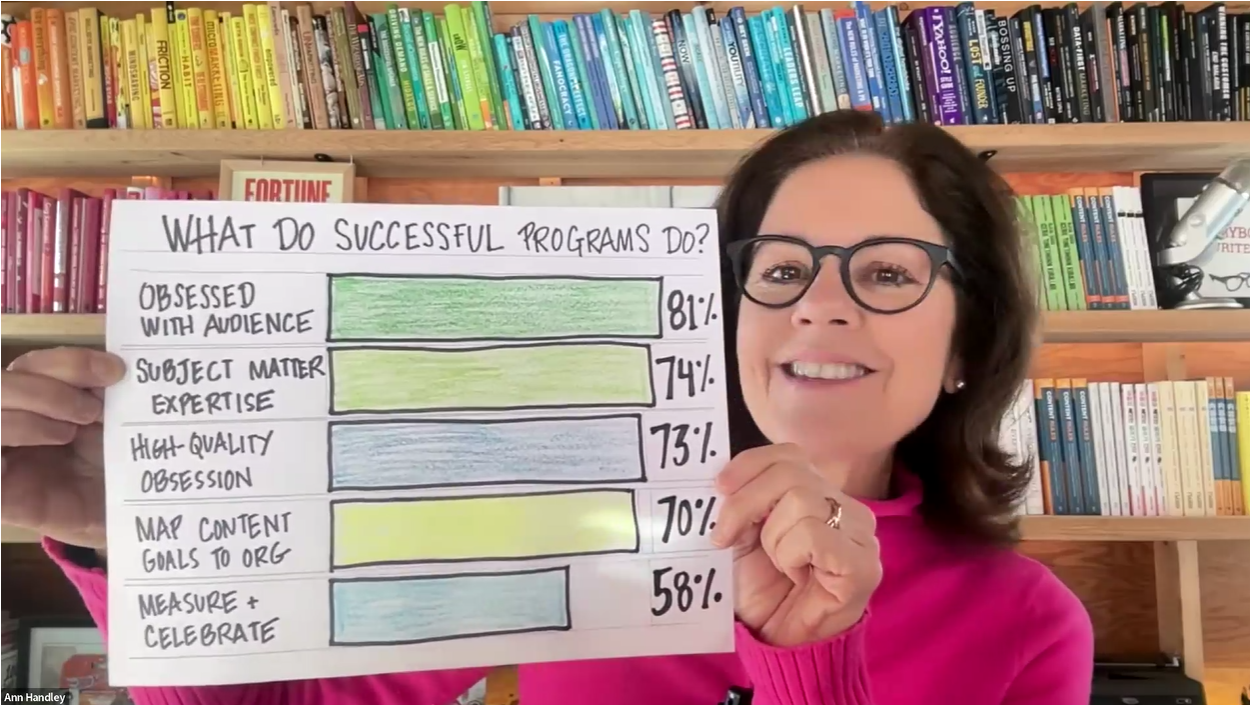
Allow me to introduce you to the concept of an analogue (or Ann-alogue, if you will) slide. This is kind of like a PowerPoint slide, but it’s on paper, and instead of using AI to create it, you use colring pencils and a Sharpie. (I’m converted. Can’t wait to sketch out my next board deck contribution.)
Ann presented an analogue slide, based on some research from Marketing Profs, on the elements of successful marketing programs, including the importance of being audience-focused, having subject matter expertise, maintaining high-quality content, aligning content with organizational goals, and measuring success. She highlighted how AI can assist in understanding the audience better, while also stressing the need for human context and expertise in content creation. Authentic and effective marketing involves all of these elements.
Audience obsession
When asked to guide marketers towards the best place to get started with this checklist for successful marketing programs, Ann recommended that we should all get a massive budget and unlimited resource, as that makes everything so much easier. However, if you’re in the 99.9% of marketers for whom that’s not an option, Ann also advised we focus on audience obsession before adopting AI tools to scale outputs.
She talked about the importance of being really clear on the value you can provide to your audience and creating content that helps specific individuals. Ann shared her approach of using email newsletters to gather insights about the audience’s needs and interests by adding a simple two-question survey to the end, and encouraging people to write back to her directly with their thoughts and suggestions. Not only does this help with deliverability, but it creates an incredible connection with the audience and provides unique audience insights and research.
Human-centric marketing strategies
Ann shared her approach to understanding her audience by responding to email inquiries, which takes about 40 minutes a week. This allows marketing to be kept human and simple. During this part of the discussion, we did again come back to how helpful AI tools can be in terms of analyzing and collating data, but we also acknowledged that there is a risk of being so focused on scaling and moving faster that we start to move away from delivering what audiences really want. Speed is cheap, efficiency is easy, but value is what marketers have a commitment to deliver.
It was also here that we began to discuss the importance of having an AI policy that sets out, at a company level, when and how your brand is open to using AI, what checks and balances you’ll have in place for AI-generated outputs (helpful hint: if you’re using the right martech tools, these safety measures will already be in place for you — did someone say Dotdigital?), and when and how you’ll communicate to your customers what parts of your marketing have been created using AI tools.
The fundamentals of creating great marketing
To finish up, we had some great audience questions for Ann, and also asked for some overarching top tips on creating marketing that audiences actually want to see. Ann advocated for a balanced approach that preserves human judgment and creativity, but allows marketers to enjoy the efficiencies offered by AI tools. Ann also gave some perfect pointers for editing AI-generated content to make sure it has warmth, empathy, and originality before being sent out into the world, so it can really do your brand voice justice.
They are:
- Look for an opportunity to make yourself laugh — if you don’t enjoy your own campaigns, you can’t expect your audience to
- Take joy in the creative process — get comfortable with knowing that parts of the process are difficult, but that’s where the magic happens
- Don’t strive for perfection, shrink the starting point, and make success accessible to yourself
- Embrace the lo-fi — high-fi is so 10 years ago — so share true stories, warts and all!
Watch the full recording here
P.S. If you’re wondering if I used AI to write this summary? I did. But, I also didn’t. I used the very helpful smart chapter summary from Zoom Webinar’s AI tool, but then I also let myself enjoy the creative process through editing and adding, and I certainly looked for an opportunity to make myself laugh!
P.P.S. To further embrace Ann’s advice, I welcome any direct responses to this blog and your suggestions for future webinar sessions. You can reach me here: katie.oleary@dotdigital.com