

How to grow email marketing revenue by sending fewer emails

A first-hand example of the impact of email, from Alannah Sneyd, Marketing Manager at Max Spielmann, part of the Timpson group.
When I joined Max Spielmann as Digital Marketing Manager in August 2024, I inherited an email program that looked busy but wasn’t actually working.
You know the setup:
- Hundreds of thousands of contacts
- Constant sends
- Leadership asking “why aren’t we seeing results?”
The answer was uncomfortable but clear. We were doing a lot, but we weren’t doing it smart. Here’s what happened when we stopped sending to everyone and started sending to the right people.
Why our high-volume email strategy wasn’t working
Max Spielmann has been turning memories into printed photos and personalized gifts for over 70 years. We’re part of the Timpson Group, with stores across the UK in supermarkets and high streets. But our email program was stuck in a different era.

The problems were stacking up:
- We had a massive database bloated with inactive contacts from in-store photo kiosks Segmentation was based only on open rates (thanks, iOS privacy updates)
- We had a “sales are down, send another email” mentality instead of strategy
- Our automations showed customers generic category pages instead of the actual products they’d looked at
- And no one was really owning email as a channel
For a small team managing marketing across multiple Timpson Group brands, something had to change.
Cleaning up data for better results
Working with my Dotdigital Customer Success Manager, we tackled the scariest part first: our contact list.
I discovered that people signing up through in-store photo kiosks had engagement rates way below those who signed up on our website. These contacts were inflating our send volumes but contributing almost nothing to revenue.
What we did
Step 1: Focusing on the contacts that actually matter
We got ruthless and removed long-term inactive kiosk customers, dropping our average newsletter sends from 323,000 to 63,000. We also introduced double opt-in for new kiosk sign-ups because quality beats quantity every time.
People get nervous about reducing volume, and I did too. But with the right insights in place, testing it on a handful of newsletters was enough to show the impact.
We also rebuilt our segments from scratch based on what actually matters like:
- Click behavior
- Browsing activity
- Purchase recency
Step 2: Making our automations smarter and more relevant
Our browse abandonment emails were sending customers to generic category pages and our welcome series was asking people to leave reviews, without knowing if they’d even made a purchase. And all it took to show improvements were a few simple changes:
- Now our browse abandonment shows customers the exact products they looked at, not a “here’s everything” link
- We extended the journey with a follow-up email to give people another nudge
- And we added purchase checks to the welcome series so customers who’d already bought didn’t get irrelevant review requests
It was a mix of technical setup, design refresh, better messaging, and rules that just weren’t there before. We also tested consistently throughout the year because we needed to know what resonated before peak season hit.

Step 3: Planning peak season with data-driven emails
With cleaner data and smarter automations, we approached Christmas differently. Instead of panic-sending to everyone, we sent more strategically while actually reducing volume.
For December 23rd (consistently our biggest shopping day), we pulled back on discounting and focused on convenience messaging for last-minute shoppers. It worked.
The monthly calls with my Dotdigital Customer Success Manager made all of this possible. For a team our size, having someone I can bounce ideas off and get answers from has been invaluable. I bring challenges, and he gives me the blueprint to execute.
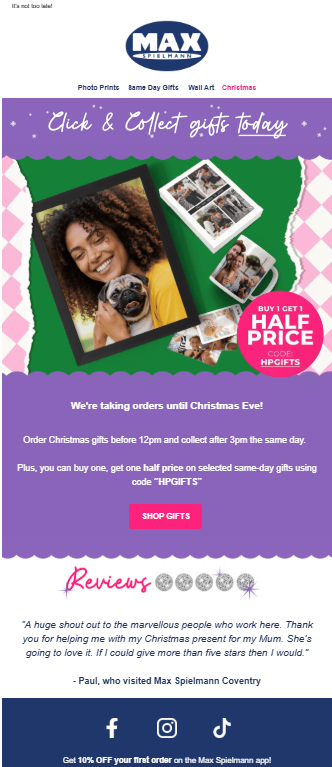
The results
Here’s what happened during our peak period:
Overall email performance:
- Revenue up 41% year over year
- Sends down 63% year over year
- Open rates jumped from 35% to 42%
- Click-through rate doubled from 1.58% to 3.17%
Automation performance:
- Revenue up 78% year over year
- Automations now drive 38% of total email revenue (up from 30%)
- Conversion rate more than doubled from 17% to 37%
The results aren’t just from cutting inactive contacts. They came from testing, better designs, and consistently sending relevant emails to relevant people over time.
My recommendations for other marketers
The numbers got people’s attention, but the efficiency story really resonated with leadership. Senior people in the business like results that make sense. The fact that we drove growth with fewer sends (and didn’t have to spend more) went down really well. Especially when other channels are getting more expensive year over year, having email working better isn’t just a good story internally.
I’m definitely getting more questions about email than I was before. It’s become a strategic conversation, not an afterthought.
Why this worked
Dotdigital has been really good for us. The drag-and-drop builder means I can make changes myself without waiting on developers. The automation builder with visual notes means I can document why I built things a certain way, which is crucial when you’re managing multiple brands.
You wouldn’t think a 150-year-old business like Timpson is doing sophisticated email marketing in the background. But we are, and we’re doing it with a really small team. You don’t need massive resources. You just need the right approach and the right partner.
What’s next
In-store data is the big opportunity. We could almost replicate all our email campaigns around those kiosk machines if we sorted out the data properly. Multi-channel expansion is on the radar too. SMS and WhatsApp are still untapped, and for customers using their phone to get photos onto the kiosk, it makes sense to explore those channels.