

How to create a brand voice guide that AI can actually use

Including your AI-friendly tone of voice template
(Scroll to part two below if this is the only reason you’re here. We won’t judge).
Whether you call it a tone of voice, brand voice or verbal identity, the language, tone and style of writing used within your organization, from emails, to web pages, to adverts and beyond – is how your audience build a connection with your brand – or not, as the case may be.
Taking a well thought through and consistent approach to your brand voice also ensures your audience can recognize you across all channels and content formats, and helps them decide if they can/should trust you.
A strong, relevant, memorable brand voice is also the difference between content that gets lost in the noise, and content that actually drives conversions.
Creating brand voice prompts
AI can be a great content creation tool, when used smartly. But, if your brand voice isn’t clearly defined and laid out in a way that can be used to train AI engines, the AI won’t magically figure it out in its own.
AI engines are only as good as the prompts you give them. So, if you’re using vague prompts like:
“Write a blog about email marketing”, you’ll get an instantly forgettable, slightly robotic, bland blog that is unlikely to offer any unique perspectives or key takeaways.
But if you use a prompt specifically designed with your brand voice guide, the AI starts sounding like you. The content becomes more unique, and the take-aways get much more relevant for your audience.
Obviously, in order to create these very specific prompts, you need to start by creating a brand voice guide.
What does a good brand voice guide look like?
It’s not a long, boring document that no one reads. It has to be a punchy, simple, clear and cohesive content operating system, that your entire organization understands and buys into.
It should tell humans and AI:
- How your brand sounds
- What your brand stands for and believes in
- What you would never say (including individual words that you want to stay away from because they’re over used or too AI-sounding)
- Why your content exists in the first place
- What makes you unique
- What makes you authentic, trustworthy and likeable
Without those clear brand voice principles, your content becomes guesswork that’s all a bit messy. And your customer journey becomes less of a joined up story, and more a complicated puzzle.
Start with a strong foundation
Before creating your guide, or any individual content, answer this:
Why should anyone care about your content?
If you can’t answer that clearly, your audience won’t know either.
Your guide should define:
1. Your purpose
- What is this content trying to do?
- What should the audience think, feel, or do after reading?
2. Your audience (be honest)
- Who are they really?
- What do they care about?
- What do they hate reading/watching/hearing?
- What do they love reading/watching/hearing?
Your content principles (non-negotiable)
If your content doesn’t do at least one of these things, don’t publish it:
- Inspire → make people want to be better
- Inform → teach them something useful
- Entertain → earn attention
- Have a clear purpose → no filler
- Offer a unique perspective → not the same take as everyone else
If it does none of the above – it’s just noise.
Define your brand personality (the fun bit)
This is where most brands go wrong. They describe themselves like this:
“Professional, innovative, customer-centric”
Which translates to:
“Exactly the same as everyone else”
Instead, define your voice in contrasts:
- We’re human – not corporate
- We’re clear – not complicated
- We’re confident – not arrogant
- We’re playful – not try-hard
- We’re memorable – not safe
Make it impossible to confuse your voice with someone else’s.
Bring it to life (this is what AI actually needs)
This is the part most guides miss, and the part that makes AI useful.
Show it how you write
Not just what you believe. Tell it what phrases and sentences you want to avoid and what to replace them with instead. Example swaps:
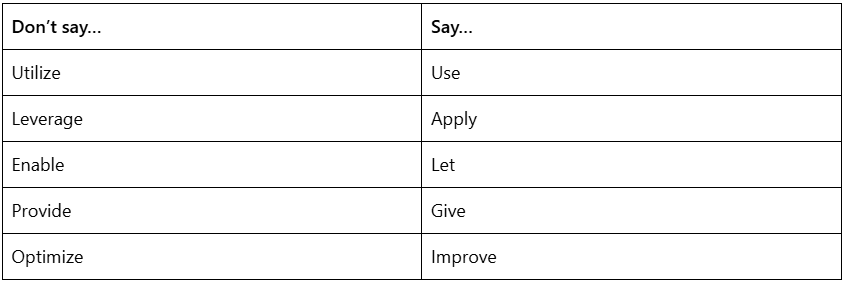
Set clear writing rules
- Write how you speak (if you wouldn’t say it to someone in your office, don’t expect them to read it on your website)
- Keep sentences short (but not too short. Multiple short sentences start to sound like an old-school advert)
- Cut anything that feels like filler (be really ruthless with your editing)
- If it doesn’t make sense, instantly rewrite it (if it confuses you, your audience have no chance)
- Read it out loud (if it doesn’t sound human, it’s not ready to publish)
Every word counts
There are certain words that AI tools LOVE and readers hate. This is because they’re not conversational, they don’t add value and they’re incredibly over used. So be clear on what words you want to ban (yes, actually ban) from your organization’s copy at all levels (not just marketing materials but 1:1 emails too) and make every single employee familiar with that list, as well as your AI engine of choice.
Some examples of overused AI words include:
- Leverage
- Transform
- Supercharge
- Revolutionize
- Best-in-class
- Empower
- “In today’s world…”
Without boundaries, AI defaults to clichés and cliché kills credibility.
Don’t publish anything without a human authenticity test
Whether you’ve used AI to create your content, or written it yourself, before anything goes live, ask:
- Would I actually read this?
- Would I understand it instantly?
- Would I share it?
- Could this be written by any other brand?
Depending on the answers to the above, you may need to do some human editing, or refine your AI prompts and try again.
So where does AI fit in?
AI is an amazing content amplifier, ideator, and junior copywriter. It’s also great at repurposing content for multiple channels. When used well, it can:
- Speed up production
- Remove blank page anxiety
- Help you scale content at pace, without extra resource or budget
But only if it understands your brand.
The problem with generic LLMs
If you’re using AI without training it on your tone of voice, you’ll get:
1. Safe, middle-of-the-road content
- Nothing offensive
- Nothing memorable
2. “AI voice”
You’ve seen it:
- Overly polished
- Slightly unnatural
- Weirdly enthusiastic
- Robotic sounding words that no one has used since 2012
3. Inconsistent brand identity
Every piece of your content will sound different:
- No recognition
- No consistency
- No trust
- No brand tone
- No joined up journey
- Just content chaos
This is where Dotdigital’s WinstonAI changes the game
When you upload your brand voice guide into Dotdigital, WinstonAI is no longer working with generic prompts. You’re providing context, boundaries and a gold standard of brand voice etiquette. In return, you’ll get email and SMS content that is on-brand, consistent, uniquely yours, recognizable and ready for light refinements if needed (not entire rewrites or heavy editing).
*Other AI engines are available if you’re not yet a Dotdigital customer – but we’d really love to work with you, so check out the Dotdigital platform here.
How to make your brand voice guide AI-ready
Before uploading, make sure your guide includes:
- Your brand identity
- An overview of your audience
- Your voice and tone principles
- Language do’s and don’ts
- Preferred words and phrases
- Banned words and phrases
To make this really easy, we’ve included a template below that you can copy and paste, and have fun completing it.
Final reminder
If your brand voice is generic, your content will be too.
Make it uniquely yours.
Part 2: Your brand voice template
Copy, paste, and fill this in, with a strong coffee and positive attitude!
1. Purpose of our content
Our content should make the audience:
We create content to: Add your purpose here
Think:
Feel:
Do:
2. Our audience
Our audience is:
They care about:
They’re tired of:
Their level of knowledge is: Are they expert, intermediate, or just getting started?
3. Our content principles
Our content must, add examples of how you’ll achieve the following:
☐ Inspire
☐ Inform
☐ Entertain
☐ Have a clear purpose
☐ Offer a unique perspective
4. Our brand personality
We are:
We are not:
5. How we write
Tone guidelines
We say:
We avoid:
Word swaps
Don’t say:
Say:
6. Banned words and phrases
We never use:
We use sparingly:
7. Content checklist
Before publishing we ensure all content has:
☐ A clear purpose
☐ Is easy to understand
☐ Follows our brand tone
☐ Avoids jargon
☐ Adds unique value to our audience
8. Our AI methods
When using AI (ideally Dotdigital’s WinstonAI):
We will:
- Use this guide as input
- Refine outputs, not blindly publish
- Maintain human oversight
We will not:
- Generate generic content without guidance
- Ignore tone of voice
- Publish without editing
9. The authenticity test
Before the content goes live, we ask ourselves:
- Would I actually read this?
- Would I understand it instantly?
- Would I share it?
- Could this be written by any other brand?