
12 marketing automation examples that work (with proof)

The key to successful marketing automation is sending the right message, to the right person, at the right time. But of course, you already know that.
But, you might not know what other brands are including within their automated sequences – and what is actually driving results.
So, we’ve collated 12 real examples from Dotdigital customers (with their permission – obviously) to give you a sneak peek at what’s working across multiple industries. Each example tackles a different stage of the customer lifecycle from the first hello, to winning back customers who have stopped engaging.
What are some real-world examples of marketing automation?
From welcome emails to win-back campaigns, marketing automation can work at every stage of the customer journey. Here are twelve examples from real brands with the results to prove it.
1. Welcome emails
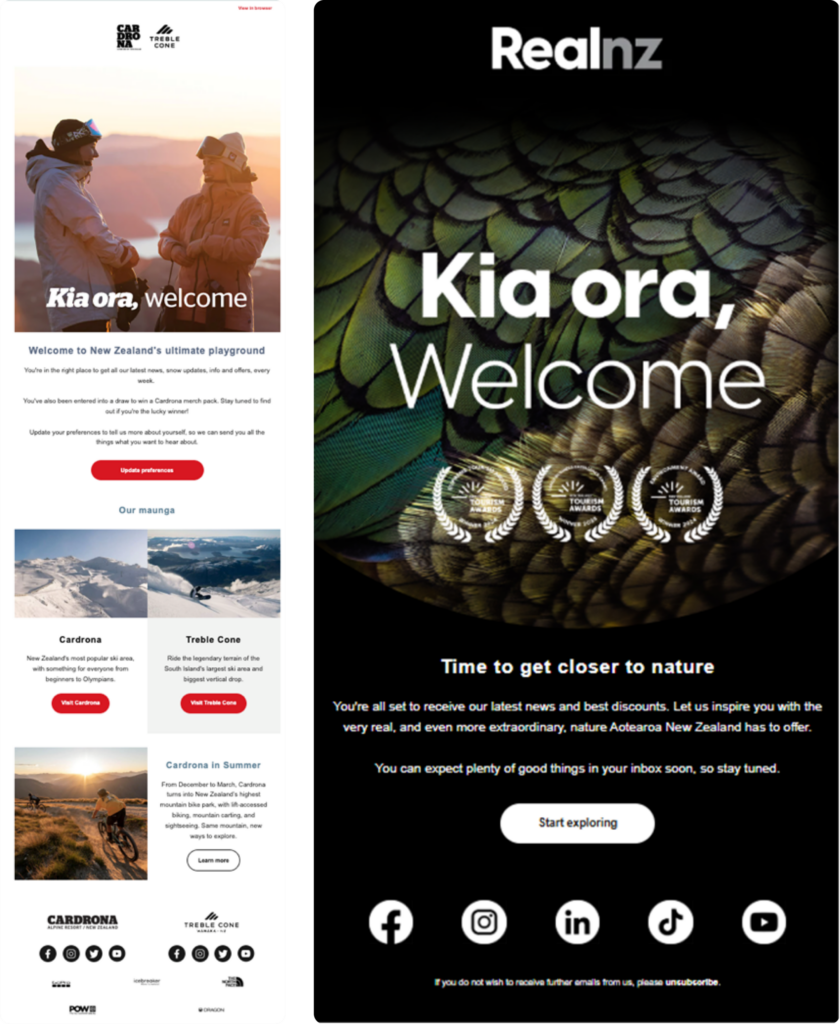
Make a strong first impression: RealNZ – Travel
The window between a customer booking and actually showing up is prime time for marketing. RealNZ, a New Zealand tourism company, knew that, but their previous platform couldn’t deliver the kind of timely, personalized communication that moment deserved.
With Dotdigital, they connected their booking data and set up triggered welcome and post-purchase emails, automatically populated with what each customer had booked and recommendations for extras to make their trip even better.
The results:
- 53% open rate on post-purchase campaigns
- 614% increase in purchases made via email year-on-year
- 13x ROI increase
2. Triggered emails and reminders
Respond in real time: Essentra Components – B2B
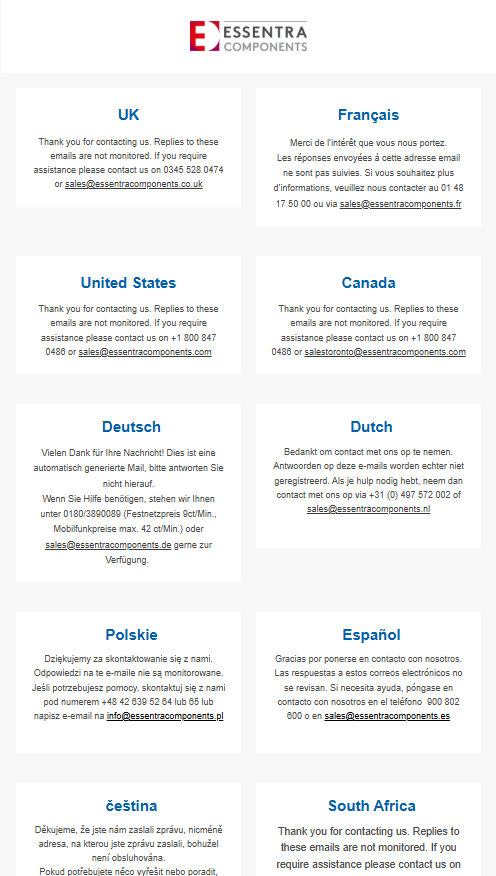
Essentra Components speaks to 1.25 million contacts across 30 countries in 17 languages. That’s a lot of ground to cover with a team of three. By integrating Dotdigital with Microsoft Dynamics 365, data passes from their CRM and website in real time, triggering over 400 automated customer journeys and 1,500+ transactional emails without anyone manually hitting send.
When a customer clicks on a product, the right follow-up lands automatically, whether that’s a relevant alert, a reminder, or a personalized cross-sell.
The results:
- 52% increase in unique email click-throughs
- Over 1,900 active automated campaigns across multiple markets
“Hook Dotdigital up to your CRM, add product and order data, and watch your campaigns fly. Start with abandoned carts, even in B2B the response surprised us.” – Simon Wade, E-CRM Manager, Essentra Components
Respond in real time: Bristol Airport – travel
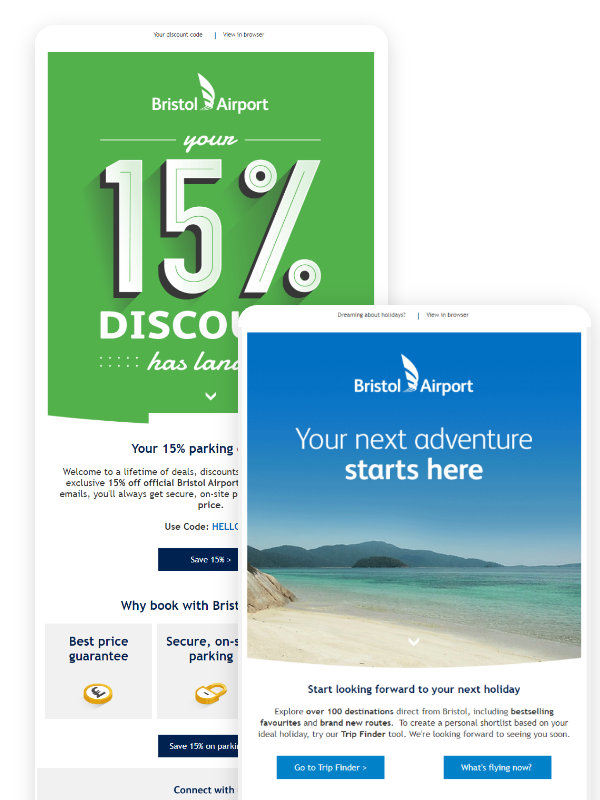
Bristol Airport used a similar approach to increase parking bookings. Stuck in a data silo where airlines owned all their passenger data, they captured new subscribers via an on-site popup and set up behavioral triggers, automatically following up with customers who clicked on parking links but never completed a booking.
The results:
- 22% of all sales attributed to email
- Discount code used in 48% of all future transactions
See how Bristol airport did it
3. Abandoned browse automation
Catch browsers before they leave: Youngevity – Health & Wellness
Someone visits your site, looks around, and leaves without buying. No cart, no transaction. It’s easy to write that off. Youngevity didn’t.
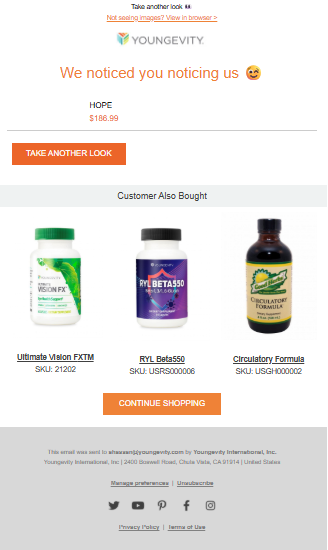
The California-based health and wellness brand built an abandoned browse program using their Adobe Commerce integration and AI-powered product recommendations, triggering personalized emails to customers who browsed but didn’t add anything to their cart. The emails show items related to what they were looking at, with incentives to come back.
The results:
- 7.7% increase in customer conversion rates
- 39% average year-on-year open rate boost
“Dotdigital offer data insights, integrations, and a user-friendly interface. The team’s expertise and guidance have helped us grow email revenue significantly.” – Aliyah Hassan Kent, Director of Digital Product, Youngevity
Read the Youngevity case study
4. Abandoned cart automation
Recover lost revenue: Champion Europe – Sportswear
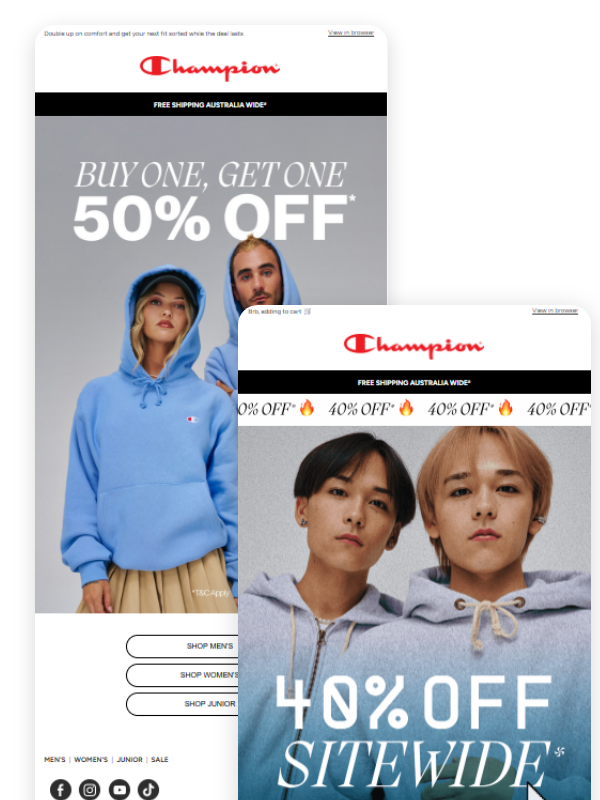
Cart abandonment is one of the most well-established automations out there, and one of the most valuable. Champion Europe, competing against billion-dollar sportswear budgets with a much smaller team, built a cross-channel abandoned cart strategy combining triggered emails with automatic Meta retargeting. Customers who leave without buying get followed up via email and shown the same items in their Facebook and Instagram feeds.
The results:
- 37% increase in cart abandonment revenue
- Email open rates exceeding 60%
“We have had some truly remarkable results, including a 37% increase in revenue in Italy from our cart abandonment campaigns.” – Irene Zaccarelli, Digital Content & CRM Manager, Champion Europe
Recover lost revenue: Harvey & Thompson – B2C
Harvey & Thompson, the UK’s largest pawnbroker, takes a more tailored approach. They built category-specific cart abandonment emails with different templates and timing rules for watches, jewelry, coins, and gold bars. That’s because someone shopping for an anniversary gift needs a different experience than someone picking up a pair of earrings.
Emails are personalized with banner imagery relevant to each category, alongside details of products still in the customer’s shopping basket.
The number of emails a customer is sent is tailored based on product value. Someone interested in a premium watch will receive a multi-stage campaign, whereas only one email is sent for lower priced items like children’s jewellery.
The results:
- £151,843 in new sales attributed to the strategy within 10 weeks
- Conversion rates almost double the UK retail sector average
“Dotdigital and Fresh Relevance’s combined functionality is helping us to replicate the personal service for which H&T has built its reputation on in-store for more than 120 years, in the digital world.” – Alicja Dela, Harvey & Thompson
Read the Harvey & Thompson case study
5. Price drop and back-in-stock alerts
Stay relevant between purchases: Würth UK – B2B
Not every customer is ready to buy the moment they discover a product. Sometimes they’re waiting for the right price. Sometimes the item they want is out of stock. The brands that stay in touch during that gap are the ones that close the sale when it finally matters.
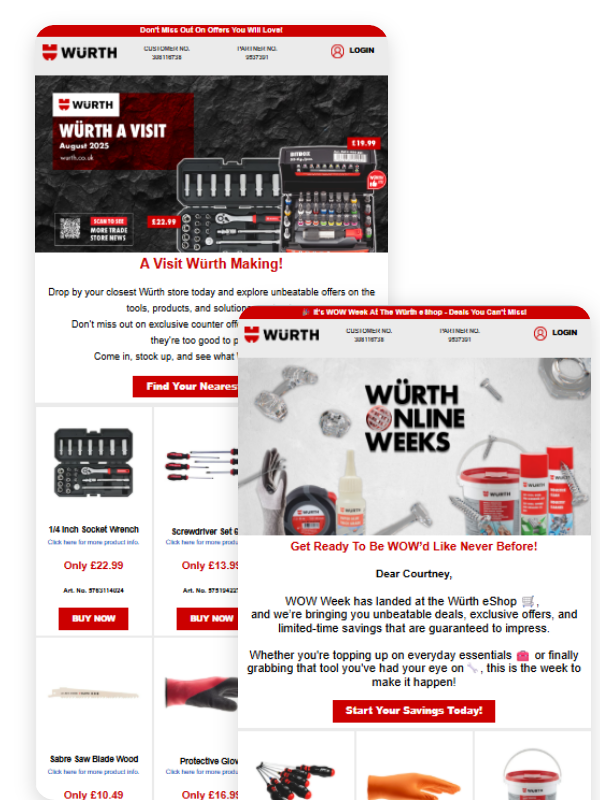
Würth UK, a B2B supplier of over 60,000 products to the automotive, agriculture, and construction industries, is rolling out automated price drop alerts and back-in-stock notifications as part of their broader marketing automation strategy. Their wider personalization work has already delivered:
- 72.4% increase in revenue
- 12.8% increase in average order value
- Almost £800k in additional revenue from abandoned cart emails alone
“The more we can automate, the more we can focus on the things that matter to us and our customers.” – Reece Smith, Head of E-Business, Würth UK
Stay relevant between purchases: Snuggle Hunny – B2C
Snuggle Hunny, the Australian baby brand, has seen back-in-stock emails deliver a 1,100% increase in click engagement compared to standard sends. It’s one of their most effective automations for reconnecting customers with products they were already interested in.
Read the Snuggle Hunny case study
6. Lead nurture
Build the case at the right place: Direct Supply – Healthcare
Some purchases take time. When the product is complex or the concept is new, a single email won’t cut it. Direct Supply, which serves senior care providers across the US, faced this when launching a next-generation foodservice robot. Most of their customers had never considered robotic food service, so the email program needed to educate an entire sector, not just sell to it.
Working with Dotdigital, they built a behavior-driven nurture program using decision nodes. Customers who clicked through and showed interest were automatically passed to the sales team. Those who didn’t were placed on a nurture track, receiving a series of educational emails that built the case step by step.
The results:
- 47% open rate on nurture track emails
- A full sales funnel of engaged prospects established from the program
“We are utilizing Dotdigital and all its tools to better automate our emails and engage our customers in new ways, leading to better conversations and more productive use of our sales team.” — Direct Supply
7. Loyalty and rewards
Reward the customers who stick around: Wittner – footwear retail
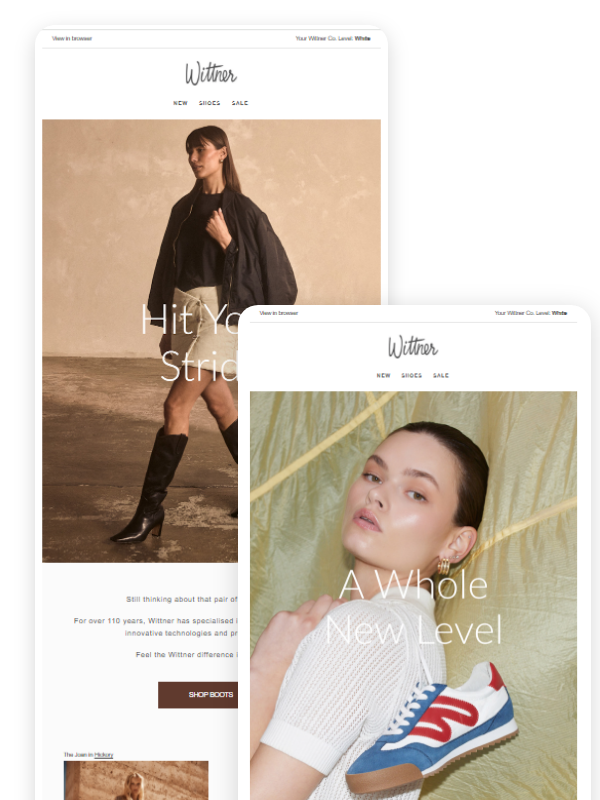
Acquiring a new customer costs significantly more than keeping an existing one. Wittner, one of Australia’s leading footwear brands, launched a tiered rewards scheme and automated every milestone within it. Move up a tier and a congratulatory email goes out automatically. Drop a level and you get a nudge with an incentive to climb back up. All of it driven by data pulled from both their ecommerce platform and point-of-sale systems.
The results:
- 86% increase in lifetime customer value
“By using online and offline data and automating customer engagement through Dotdigital we have increased loyalty and have seen lifetime customer value increasing by 86%.” – Wittner Marketing Team
Reward the customers who stick around: The Royal Ballet School – education
The Royal Ballet School shows the same principle in action outside of retail. Wanting to reward customers who had bought three or more of their online dance classes, they built an automation offering 15% off the next purchase, followed by a reminder seven days before the discount expired, with personalized product recommendations in every email.
The results:
- 77% open rate on the initial offer email
- 6.2% conversion rate — a 3,000% increase vs. one-off campaigns
“This project has proven to us the power of an ‘always-on’ email marketing automation.” – Maddy Carroll, Audience and Insights Executive, The Royal Ballet School
Read The Royal Ballet School case study
8. Lapsed customer re-engagement
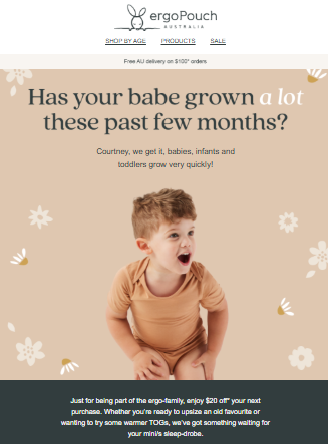
Win back the ones who’ve gone quiet: ergoPouch – Baby & Kids
Every database has them: customers who bought once, maybe twice, and then stopped. ergoPouch, the Australian brand making sleepwear safer for babies and kids, built a two-part re-engagement campaign offering a $20 coupon for a customer’s next order.
The key finding? Cutting the lapsed customer window from 180 days to 90 days made a significant difference. Warmer customers were more likely to respond, and ROI climbed as a result.
The lesson: find the sweet spot between too soon and too late, then keep testing.
The results:
- 44% open rate on the lapsed customer program
- Campaigns exceeded industry benchmarks by 10%
Build your business case for marketing automation
If you’re looking into marketing automation, you’re likely thinking about what it can do and what it means for your team and your business.
Here’s what that looks like in practice:
Do more with the same resources
Automation helps you scale campaigns without adding extra manual work, which means your team can spend more time on strategy and less on repetitive tasks.
Deliver more relevant experiences
With segmentation and behavioral data, you can tailor messages based on what people do.
Improve lead quality and conversion
By nurturing prospects over time with the right content, you can guide them closer to making a purchase that feels natural to them.
Align marketing and sales activity
Shared data and clearer journeys help both teams stay focused on the same goals, with better visibility across the funnel.
Strengthen reporting and decision-making
Centralized data and campaign insights make it easier to see what’s working and where to improve.
The numbers back it up too. 58% of marketers already automate their email campaigns, making it the most automated channel by a long way. And with 68% expecting their automation budgets to grow, it’s clear there’s a shift in how good marketing gets done.
Where to start
Across these twelve automations examples, the same idea shows up again and again: the right message, at the right time, to the right person.
If you’re just getting started, pick one. A Welcome journey is the most common starting point for a reason because it’s quick to set up and the impact is immediate.
If you’re already running the basics then have a look at what happens before and after the cart:
- Browse abandonment to catch people earlier
- Loyalty automation to keep them coming back longer
Every brand in this piece started somewhere. And every one of them got results.