

4 ways to use marketing benchmarks to your advantage

Marketers are constantly told that data should drive everything we do. But in reality, many of us are working with incomplete pictures, changing customer behavior, and growing pressure to ‘do more with less.’
Not only are marketers grappling with tight budgets and leaner teams, we’re also getting less information from our audience. Zero-click behavior is rising and privacy changes like Apple’s Mail Privacy Protection mean some metrics are less reliable than they used to be.
At Dotdigital, we are all about making marketers’ lives easier. Data is something we all need more of. Each year, we create our Global benchmark report, full of marketing data, sourced from our platform, that you can use straight away. In this blog, we’ll outline four ways you can put these benchmarks to work.
How to use marketing benchmarks
Benchmarks are more than ‘nice to know’ numbers. Used well, they become:
- Your closest source of competitor insight
- A guide for smarter strategy
- A tool for setting realistic goals
- Evidence for business cases, budget, and headcount
- Proof of impact at review time
Now let’s explore some simple, practical ways to use benchmarks to drive better results for your business and boost your own career.
1: Use benchmarks to set expectations
Whether you’re launching a new channel or refreshing the strategy for an existing one, benchmarks answer a crucial question: “What’s realistic here?”
The Dotdigital Global benchmark report can tell you:
- See what “good” looks like in your industry and region
- Understand the typical performance of each channel
- Set goals that are ambitious but achievable
In 2026, we know that email continues to be a strong, reliable channel. However, the data also tells us that while opens are rising, click-to-open rates are falling year over year. So we know that engagement is still there, but other channels are often better placed when you have important calls to action.
This is where mobile marketing channels come in. SMS and WhatsApp drive dramatically higher click-through rates, 7x and 14x email, respectively, making them ideal for driving action.
What changes when you use benchmarks this way
You stop planning in the dark and begin every project with valuable context. Accurate and achievable goal-setting means you‘ll have more confidence in your strategy and there will be fewer surprises in your results. Your work gets the time it needs to perform, without pressure to panic and pivot if initial numbers aren’t as strong as you’d hoped.
2: Use benchmarks to prioritize your strategy
Most marketing teams are stretched, and you can’t do everything at once. Benchmarks help you decide what’s worth doing next.
The Dotdigital Global benchmark report can show you:
- Which channels are underutilized in your mix
- Where the biggest performance gaps are
- Which improvements are likely to deliver the biggest returns
You can see where the biggest opportunities lie for your business and focus there first. For example, you might see that your email open rates are below average and that working on subject line optimization could improve them – hopefully adding a knock-on effect of better click rates too.
Or, you might see that your email engagement rates are above average across the board, indicating that you should look to strengthen elsewhere by adding WhatsApp to your marketing mix to get more conversions.
What changes when you use benchmarks this way
Your roadmap becomes evidence-led, based on tangible potential, and you can be confident in your approach. You’ll have clearer justification for every decision and see results quicker as you’re able to direct your attention to the biggest opportunities first.
3: Use benchmarks to win buy-in
Starting a new channel or investing in new technology can feel risky, especially to people outside marketing. Benchmarks remove the guesswork and give a tangible outcome before you make the leap.
Instead of saying, “We want to try X as we think this could work, ” you can say, “Here’s what brands like ours are achieving today.”
With industry-specific data, you can:
- Show what’s possible before you invest
- Reduce perceived risk
- Frame marketing as predictable, not experimental
- Build stronger business cases
This data makes it far easier for people outside marketing to understand the potential return on investment and weigh it against the risk. Whether you’re asking for more budget, additional headcount, or smarter marketing technology, benchmarks give your ideas credibility.
If you’re considering Dotdigital for the first time, our report is especially powerful: every benchmark comes from real Dotdigital customers, so you’re not seeing what might be possible, you’re seeing what’s already being achieved.
Appeal to C-Suite and Senior Leaders
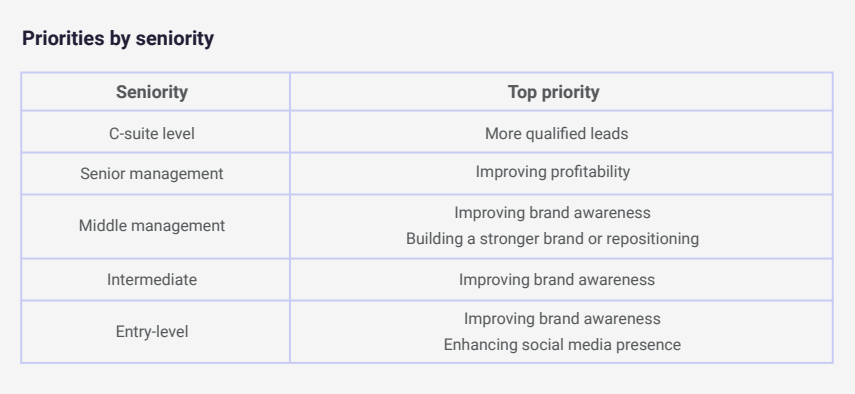
You can take this a step further by translating benchmarks into revenue. Calculate the uplift you could generate by hitting higher targets and tie that directly to business goals. Our survey of 1,500 marketers found that the C-suite’s top priority this year is more qualified leads, while senior leaders are most focused on improving profitability. Adding these benchmarks and the impact they’ll have to your business case helps you speak their language.
What changes when you use benchmarks this way
Our survey also found that HR, IT, and Finance are the teams marketers feel have the least understanding of the value of marketing. They’re also the departments many find hardest to collaborate with.
By adding in solid numbers, relationships and understanding between these teams will improve, making approvals easier and creating more trust in marketing as a business function moving forward.
4: Use benchmarks to prove your marketing impact
Many marketers know they’re doing good work, but struggle to prove it – especially as tech companies restrict tracking and customers are interacting less. Benchmarks give your performance meaning.
They allow you to say:
- “We’re outperforming our industry”
- “We’ve closed the gap by X% in six months”
- “We’re now in the top quartile for engagement”
That’s powerful in:
- Monthly and quarterly reports
- Budget discussions
- Performance reviews
- Bonus and appraisal conversations
You’re no longer just reporting numbers without context, but showing progress, impact, and value. You can show your own growth month-on-month and year-on-year, and also give a powerful view of how your performance compares to competitors. Speaking marketer to marketer, they’re also a great reference point to add to job applications.
What changes when you use benchmarks this way
Your work becomes visible, grounded in evidence, and easier to understand. Benchmarks turn your results into something the wider business can clearly see and trust. Not just your team, but the C-suite, HR, and Finance too.
That visibility brings recognition, credibility, and leverage. It helps the people who influence promotions, bonuses, and pay increases understand the real impact of your work, and the value you bring to the business.
Turning numbers into an advantage
Benchmarks aren’t about chasing averages or copying what everyone else is doing. They’re about giving you a clearer picture of where you are, what’s possible, and where your effort will matter most. Used well, they help you make better decisions and tell a more confident story about the impact of your work.
The data is available now and hopefully you’ve identified a few new ways to use it. If you’d like to explore the numbers for your industry, your region, and every major channel, you can download the 2026 Global benchmark report here.