



If you’ve ever had to justify your marketing platform choice to your boss, chief financial officer (CFO), or a procurement team, this one’s for you.
G2’s Summer 2026 rankings are out, and Dotdigital landed Leader status in 13 product categories. Getting recognized in one category is an achievement. Getting recognized in 13 shows how broad the platform is and how differently marketers use it in their day-to-day.
What does a G2 Leader status mean?
G2’s rankings are based entirely on real customer reviews. Every single one gets verified by G2, so you know it’s from a real Dotdigital user, and not just what a vendor says about itself.
Two things drive the G2 rankings:
- Customer satisfaction scores drawn from reviews
- Market presence, which factors in review volume, reach, and engagement
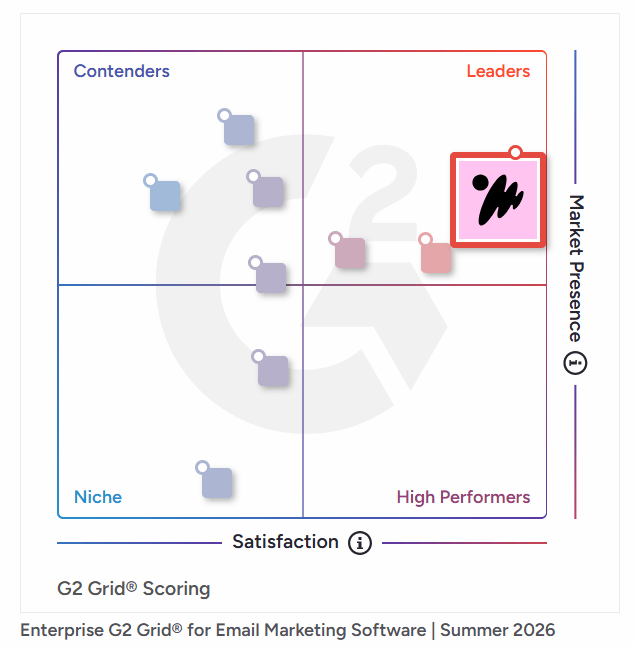
G2 plots every vendor on a grid using those two scores. Leaders sit in the top right, which means they score high on both. You can’t buy your way in or coast on brand recognition alone. Here’s how that looks for categories like marketing automation:
Which categories does Dotdigital rank as a G2 Leader?
G2 reviewers choose categories based on how they use the platform every day. These 13 categories cover the full customer engagement lifecycle, from acquisition and messaging through to data, personalization, and analytics.
- Email marketing
- Marketing automation
- Personalization
- Customer data platform (CDP)
- Email deliverability
- Communication platform as a service (CPaaS)
- SMS marketing
- Mobile marketing
- Customer journey analytics
- Email template builder
- Landing page builders
- Personalization engines
- Transactional email
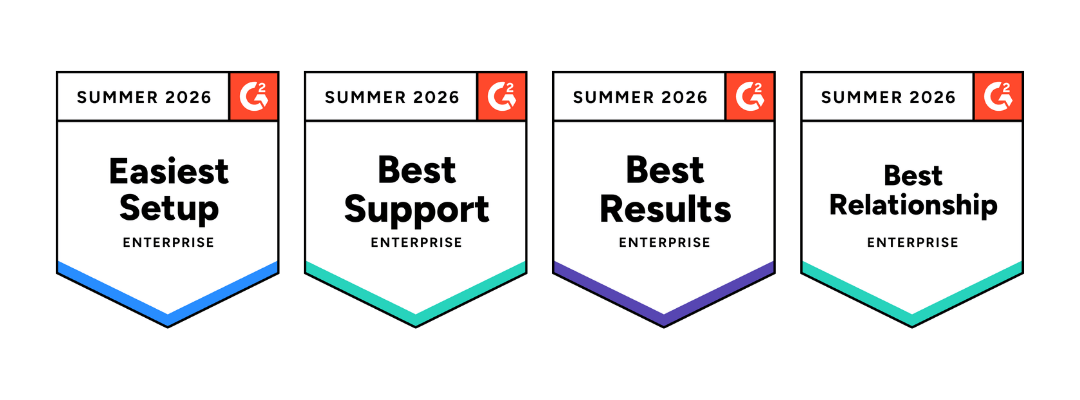
Why Dotdigital is a leader across 13 categories
More than 1,200 customers have left Dotdigital reviews on G2, averaging 4.4/5. Across those reviews, four themes keep coming up:
- Smart automation that saves time
- Accessible segmentation
- Connected cross-channel marketing
- Support from real people
Smart automation that saves time
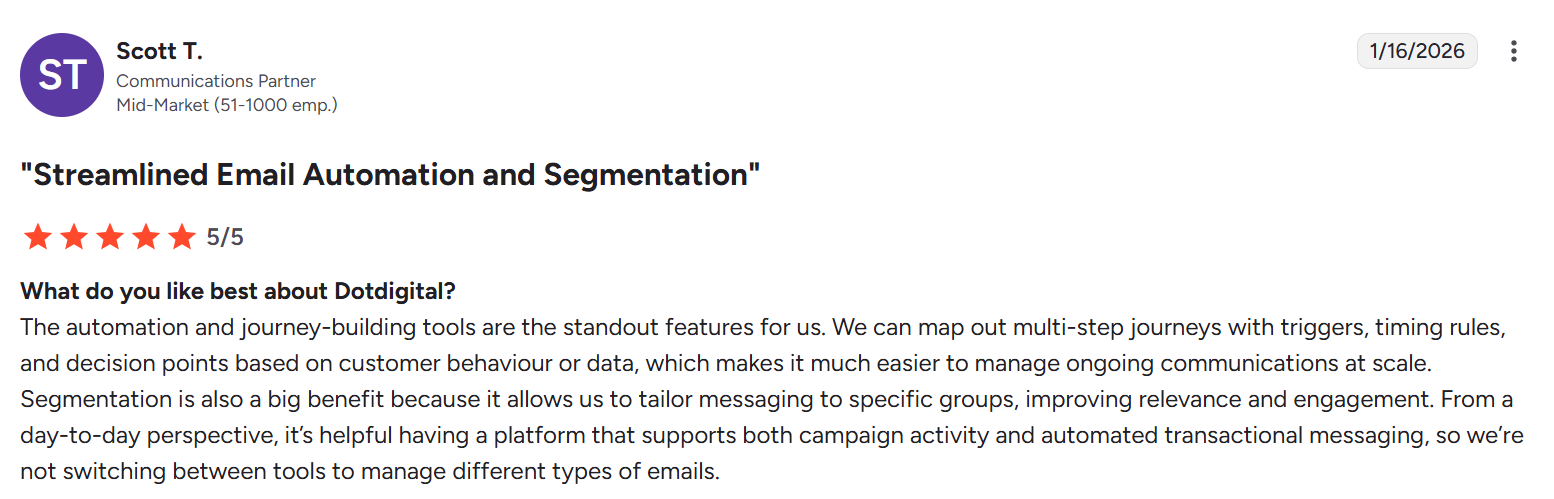
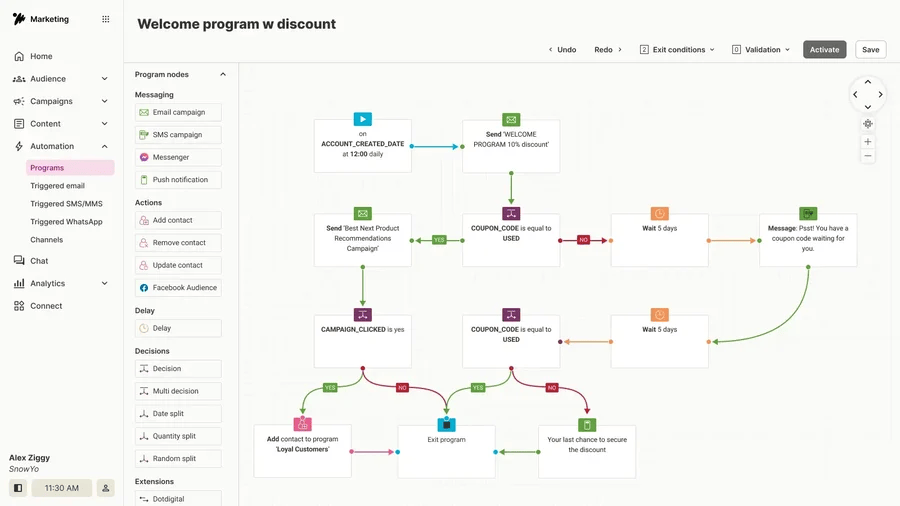
Reviewers keep mentioning how much manual work the platform takes off their plate. You can map out multi-step journeys with triggers, timing rules, and decision points, so cart recovery emails, post-purchase flows, and win-back campaigns run themselves.
It’s how Scott, a Communications Partner, keeps ongoing communications running on their own, with journeys built on triggers, timing rules, and decision points.
Accessible segmentation
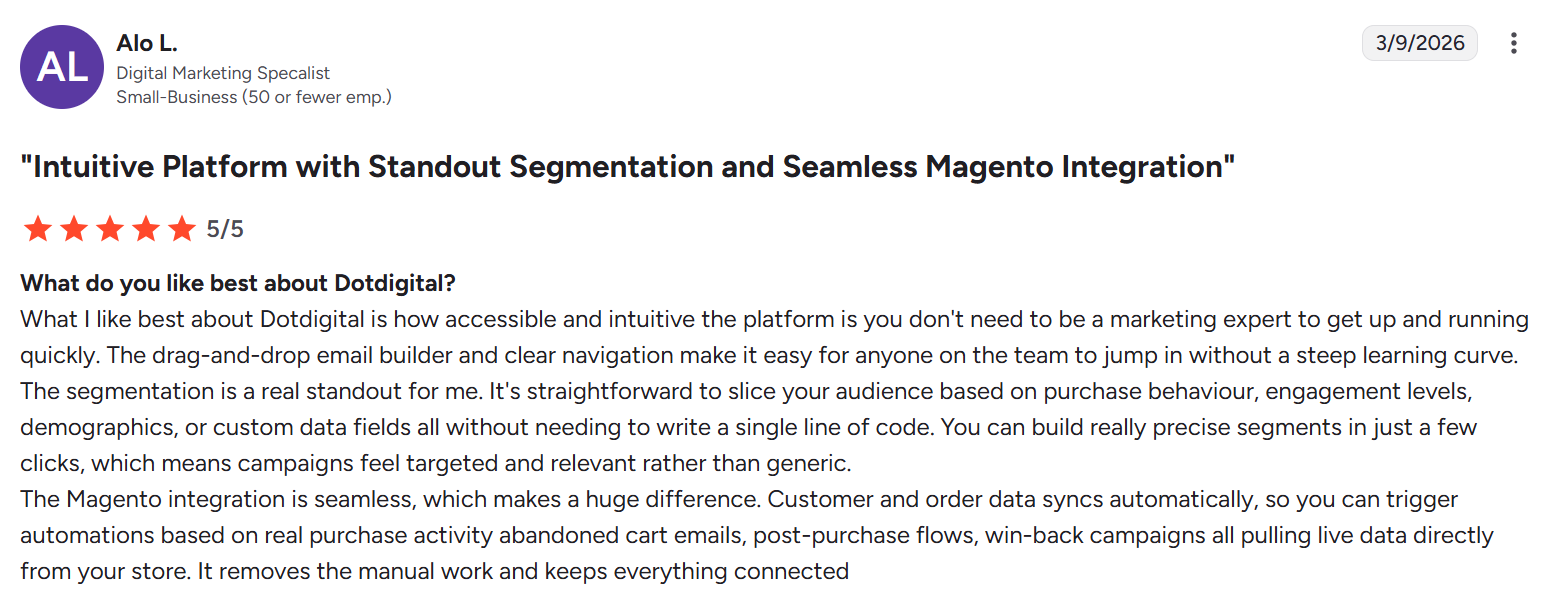
You don’t need a data team or a single line of code to build precise segments. Slice your audience by purchase behavior, engagement, demographics, or custom data fields in a few clicks. And with Segment Agent, you can now describe the audience you need in your own words and let AI build it.
It’s what Alo, a Digital Marketing Specialist, uses to build precise segments in a few clicks, with no code needed.
Connected cross-channel marketing
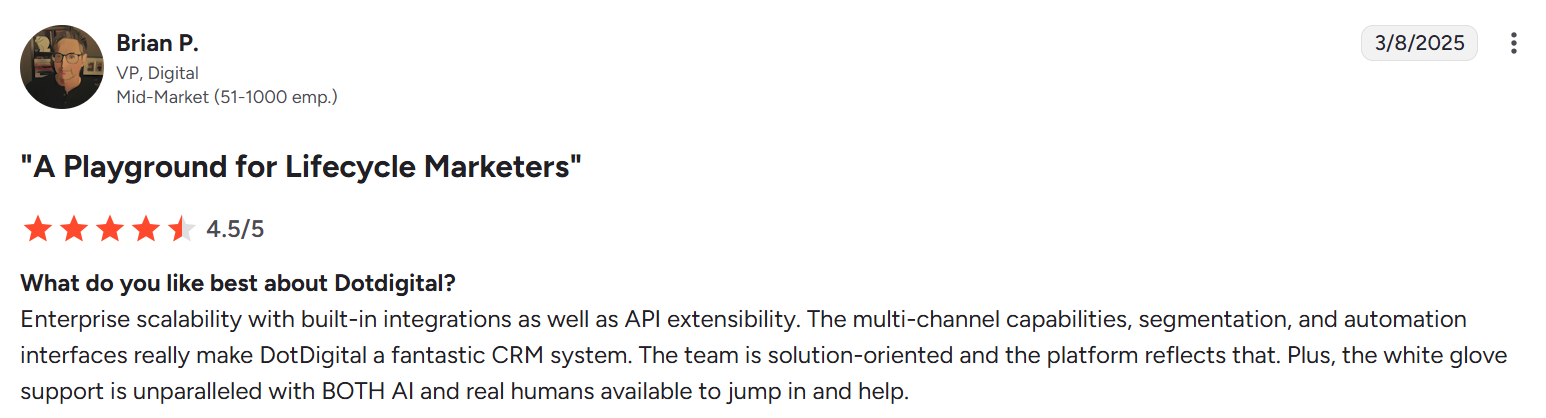
Email, SMS, WhatsApp, mobile push, web, and ads all run from one platform, with over 200 integrations feeding in your customer and order data. That’s why reviewers talk about managing everything in one place instead of juggling tools.
Brian, a VP of Digital, has run cross-channel marketing this way for years, backed by the platform’s AI and hands-on support teams.
Support from real people
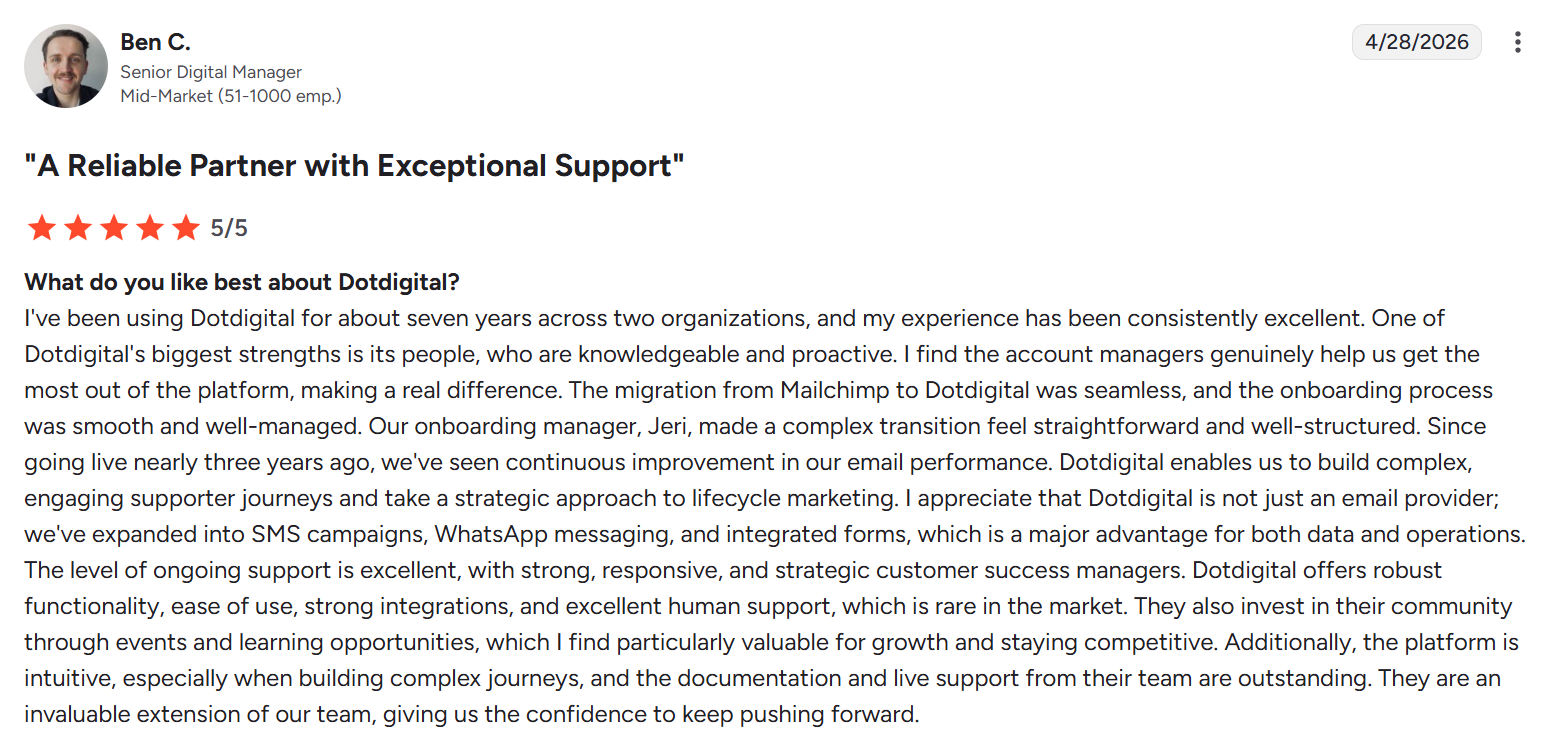
Help is on hand around the clock, with 24/7 live chat, dedicated onboarding, and your own customer success manager. It’s the theme reviewers get most enthusiastic about, and the one that’s hardest for any platform to fake.
Ben’s seen all of it, seven years and two organizations’ worth, from onboarding through to building full customer journeys.
Dotdigital named one of the best customer data platforms by G2
Our G2 recognition goes further than Leader status. G2 included Dotdigital in its roundup of the 9 best customer data platforms, alongside other platforms like Salesforce, Bloomreach, and Klaviyo.
G2 highlighted Dotdigital as best for accessible marketing automation, calling out our email, SMS, and lifecycle campaign automation as standout strengths. The list was built on real user reviews, with platforms selected based on customer data unification, segmentation, activation, analytics, usability, and integrations.
In G2’s words, Dotdigital is a strong fit for mid-market teams who want their marketers to manage automation without leaning on technical specialists for every campaign. That sits nicely alongside our 13 G2 Leader categories and reflects how customers are using Dotdigital to bring their data and marketing activity together in one place.
Read the full G2 list of the best customer data platforms.
How to use G2 when you’re choosing a marketing platform
Evaluating marketing platforms isn’t easy. There’s a lot to weigh up, and it doesn’t help that many vendors will tell you what you want to hear. Independent platforms, like G2, give you real, verified customer insights from people who use the platform every day.
Here’s how to get the most out of it during your research:
Count the Leader categories
Every G2 category is a separate contest with its own reviews and rankings. A vendor can be brilliant at email, and average at everything else, and the category view shows you that. So instead of asking “Is this platform good?” check whether it leads in the specific categories your team uses or needs. If you need email, SMS, and automation, look for Leader status in all three rather than a single overall badge.
Look past the star rating
Two platforms can both sit at 4.4 stars for completely different reasons. The detail is in G2’s satisfaction scores, where reviewers rate things like ease of use, ease of setup, and quality of support as separate questions. Decide which of those matters most to your team before you compare.
Check how recent the reviews are
Marketing platforms change fast. A vendor coasting on praise from three years ago may be a different product now. Filter reviews to the last 6 to 12 months and see whether the same strengths keep coming up. Consistent recent praise for the same things is a much stronger signal than a high all-time average.
Compare vendors within the same category
It’s hard to compare platforms from their own websites because everyone describes themselves differently. G2’s category grid fixes that by scoring direct competitors on the same criteria and plotting them side by side. Pick the category that matches your use case, shortlist from the grid, then read reviews for each vendor on your list.
Look at who’s leaving the reviews
A review from a 5,000-person enterprise tells you little if you’re a team of four, and the reverse is true, too. G2 shows reviewer job titles and company sizes, so filter for companies that look like yours. Their experience of onboarding, support, and day-to-day use is the closest preview you’ll get of your own.
If you’re a Dotdigital customer and haven’t left a review yet, it genuinely makes a difference.
Head to our G2 profile and share your experience. It takes less time than you’d think.
