


WhatsApp started as the app you and your friends used to swap dinner plans and memes. These days, billions of people use the app to talk to each other, and are increasingly open to messages from brands they care about.
But WhatsApp isn’t just another channel to add to your marketing stack for the sake of it. It’s delivering standout engagement that exceeds expectations, and if you’re not already using it as part of a thoughtful, permission-based strategy, now’s the time to start.
What marketers are saying about WhatsApp (and why the numbers back them up)
WhatsApp has 2.5 billion monthly users. The average person spends 33 minutes a day on the app. In Dotdigital’s Global Benchmark Report 2026, we found that it delivers an average click-through rate of 51.1%, which is ten times higher than email.
When you look at those numbers together, it’s easy to see why marketers are investing in WhatsApp. It’s where customers already spend time and actively engage, making it a natural part of the channel mix.
And when WhatsApp sits alongside your email and SMS on the same platform, it becomes even more powerful. You can trigger messages from the same customer data, build it into your existing journeys, and manage it without needing to jump between tools, manually export or import customer data, or have more places to manage marketing consent
Here at Dotdigital, we’re big fans of WhatsApp, but don’t just take our word for it. We went straight to the source and asked marketers already on the channel to share how they’re finding it.
How Ultima Media uses WhatsApp to reach 90% open rates across event journeys
Ultima Media is a B2B media company that connects the automotive manufacturing, logistics, and design industries through expert content and professional events.
Like most event-led teams, email was doing a lot of the heavy lifting. But with crowded inboxes and fast-moving schedules, important updates weren’t always being seen when they needed to.
The brand now uses WhatsApp to manage the full attendee journey across three stages:
- Pre-event: Branded messages with imagery and multiple links to build anticipation and share logistics
- During the event: Real-time updates, timing reminders, relevant articles, and links like photo albums
- Post-event: On-demand content distribution and promotion of related products
Open rates have reached as high as 90%, which shows how engaging WhatsApp is as a marketing channel, particularly for messages that contain important updates or are time-sensitive
To keep things running smoothly, Ultima Media now captures WhatsApp opt-ins at registration. Mobile number is a required field, so every new attendee enters the journey WhatsApp-ready.
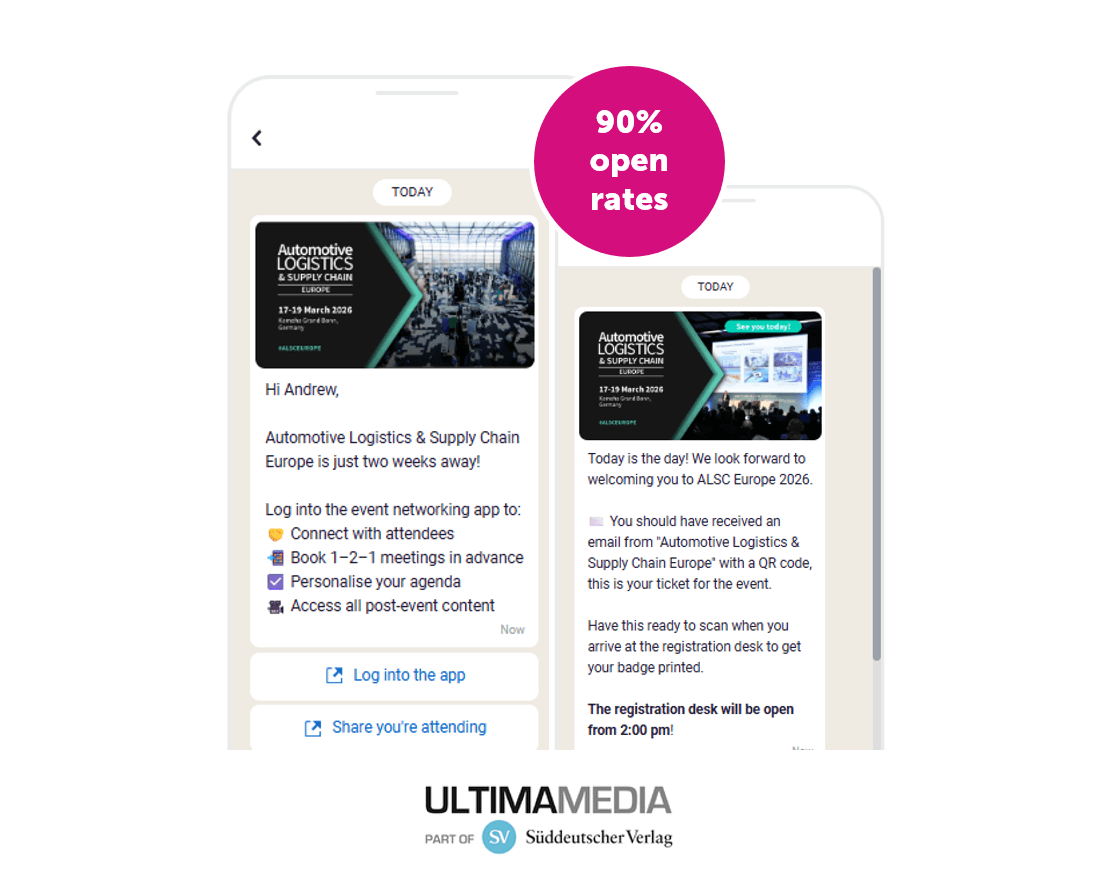
“We use WhatsApp as a real-time concierge throughout the entire attendee journey. Unlike email, which gets buried in crowded inboxes, WhatsApp is more likely to get read. And unlike SMS, it lets us send fully branded messages with rich imagery and clear link previews, so attendees feel confident clicking. WhatsApp keeps the entire event journey in one continuous thread. It feels like a reliable resource rather than a series of disconnected alerts.”
– Giada Nacucchi, Marketing Manager, Ultima Media
What this means for you
What’s interesting here isn’t necessarily the open rates, but it’s more about how WhatsApp fits into the wider customer journey.
For Ultima Media, it works because the communication is time-sensitive, structured, and part of a clear experience from start to finish. Nothing feels isolated, and each message supports the next step in the attendee journey.
Using WhatsApp marketing gives teams a way to keep high-attention moments in a single, continuous thread, especially when timing really matters.
The takeaway is thinking less about WhatsApp as a standalone channel and more about where it strengthens the journeys you already have in place.
How Lease Loco grew a new WhatsApp channel to 80%+ open rates in three months
Lease Loco is a car leasing comparison site with an established email and SMS program, but they wanted a way to share richer, more detailed offers than SMS allows. So, WhatsApp felt like the natural next step.
The team uses it to share its best deals with either its full subscriber list or targeted segments, with full deal specs, pricing, and imagery that SMS simply doesn’t have space for.
It gives the brand a more flexible way to communicate offers that need more than a short line of text.
Open rates now range from 78% to 81%, with the WhatsApp subscriber base growing by 43% in just three months.
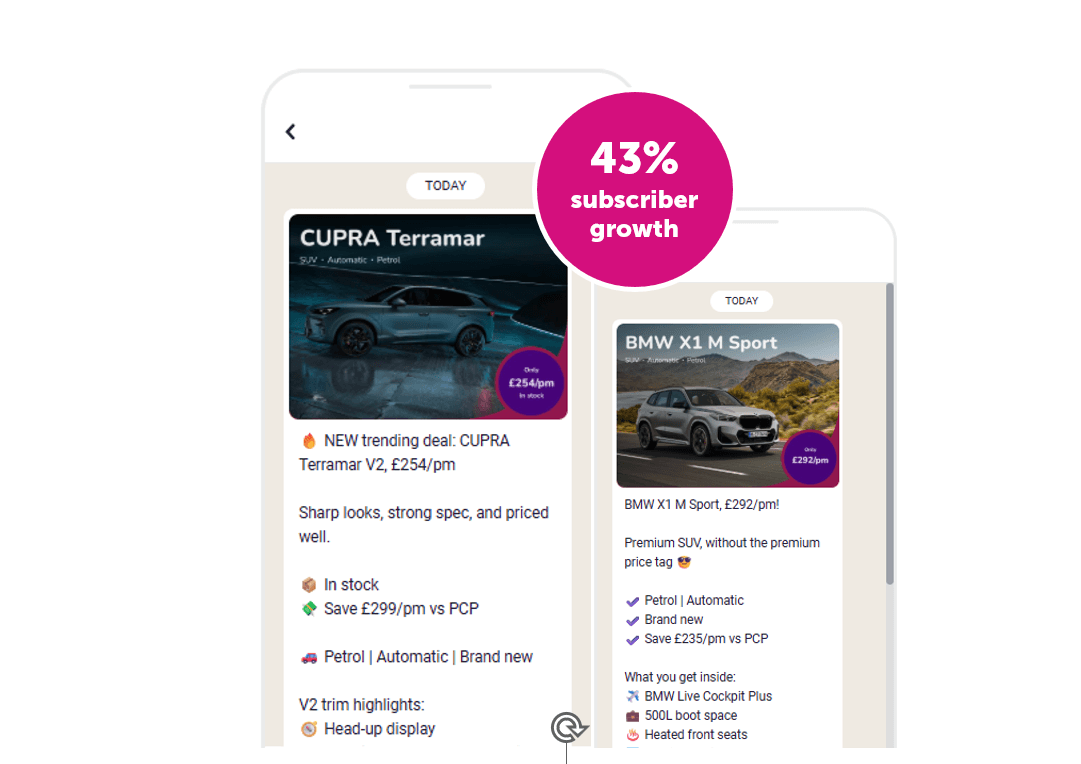
“We’ve built WhatsApp into our marketing mix as a natural next step after email and SMS,and it’s already proving its worth. What makes WhatsApp exciting for us is the freedom it gives you compared to SMS. No character limit, rich imagery, emojis, full deal specs. For context, our WhatsApp lead volume is already around a third of our SMS channel, despite having a much smaller, newer subscriber list.”
– Michaela Crawford, Digital Marketing Manager, Lease Loco
What this means for you
What stands out here is how quickly WhatsApp can slot into an existing setup.
Lease Loco extended their strategy rather than doing a full rebuild because email and SMS were already driving results. WhatsApp just gave them another way to show high-intent offers with more detail and more visual impact.
The takeaway is that WhatsApp doesn’t need to start as a big, complex programme. It can begin as an extension of what you’re already sending, especially for content that needs more space than SMS allows but more immediacy than email.
How Bolsover Cruise Club drove 80%+ open rates with personalized WhatsApp messaging
Bolsover Cruise Club is one of the UK’s leading independent cruise specialists. With a strong SMS program already in place, WhatsApp gave the team a way to build on what was already working, with richer and more flexible messaging.
The team uses it to reach both existing and prospective customers with exclusive offers, new cruise launches, and partner campaign updates. What’s changed is the variety in how these messages can be displayed, and how it fits into the recipients’ day, landing on a channel that they’re already spending time on.
WhatsApp has opened up more room for personalized, automated communication, with richer content and a cadence that feels natural rather than intrusive.
And that’s reflected in the results, with open rates sitting above 80%, and early sign-up demand exceeding their expectations.
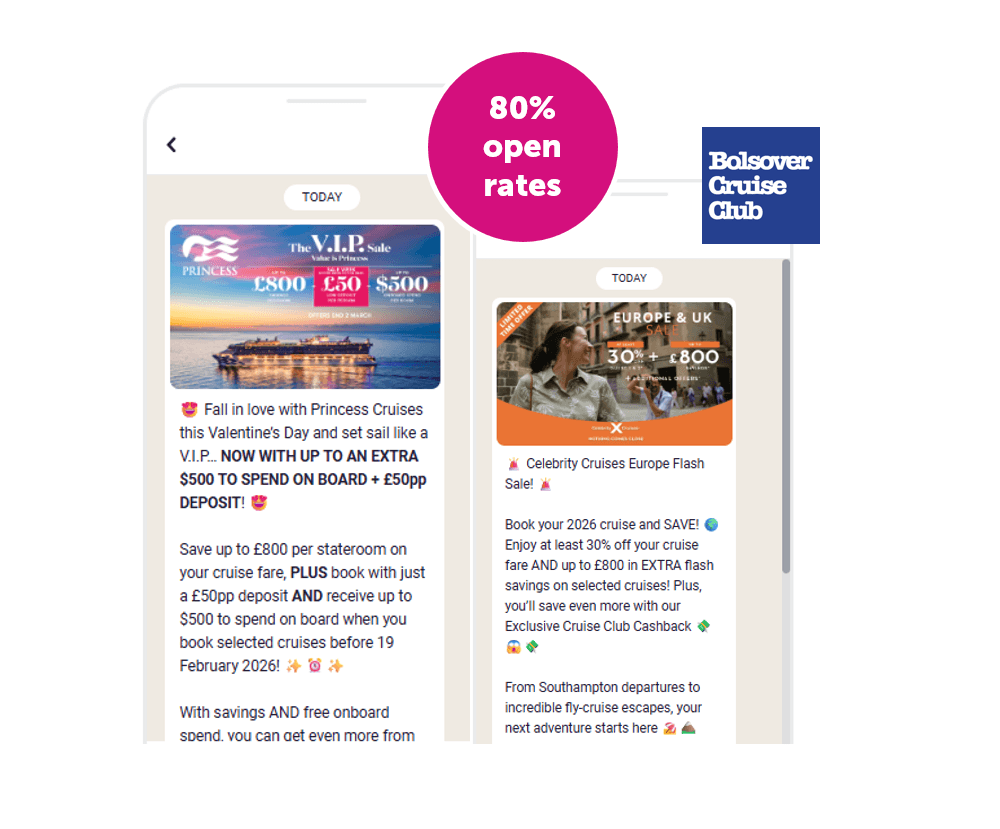
“We’d already seen sustained success with SMS, but WhatsApp opened up a whole new level of personalization and automation, with richer, more engaging content and the ability to communicate more regularly without it feeling intrusive. We use it to reach a mix of existing and prospective customers with exclusive offers, new product launches, and key partner campaign updates.
The appetite for sign-ups has been incredible, and the engagement speaks for itself. WhatsApp currently has far less noise than email, which means your messages genuinely cut through. We’re still in the early stages, but I’m convinced the best is yet to come.
My advice to any travel brand on the fence? Be an early adopter. Get ahead now while the opportunity is there.”
– Danny Forsythe, Head of Marketing, Bolsover Cruise Club
What this means for you
This example shows how WhatsApp works best when it’s used consistently and not just for standalone campaigns.
For Bolsover Cruise Club, WhatsApp has become a way to deliver more personalized messaging, support automation, and keep engagement high, without feeling crowded.
The opportunity here is building WhatsApp into your broader communication strategy early, while attention is still strong.
How a UK pub chain drove 82%+ open rates by shifting from telesales to WhatsApp
This UK hospitality brand was relying heavily on telesales and email to reach customers. With email engagement declining, the team needed a better way to stay connected with its audience without adding complexity to its setup.
The brand now uses WhatsApp to send promotions, business updates, and service messages, targeting either specific customer groups or its wider base, depending on the message.
By changing to this strategy, the brand has seen open rates at around 82%, compared to 48% for email, which shows how much more attention WhatsApp is getting.
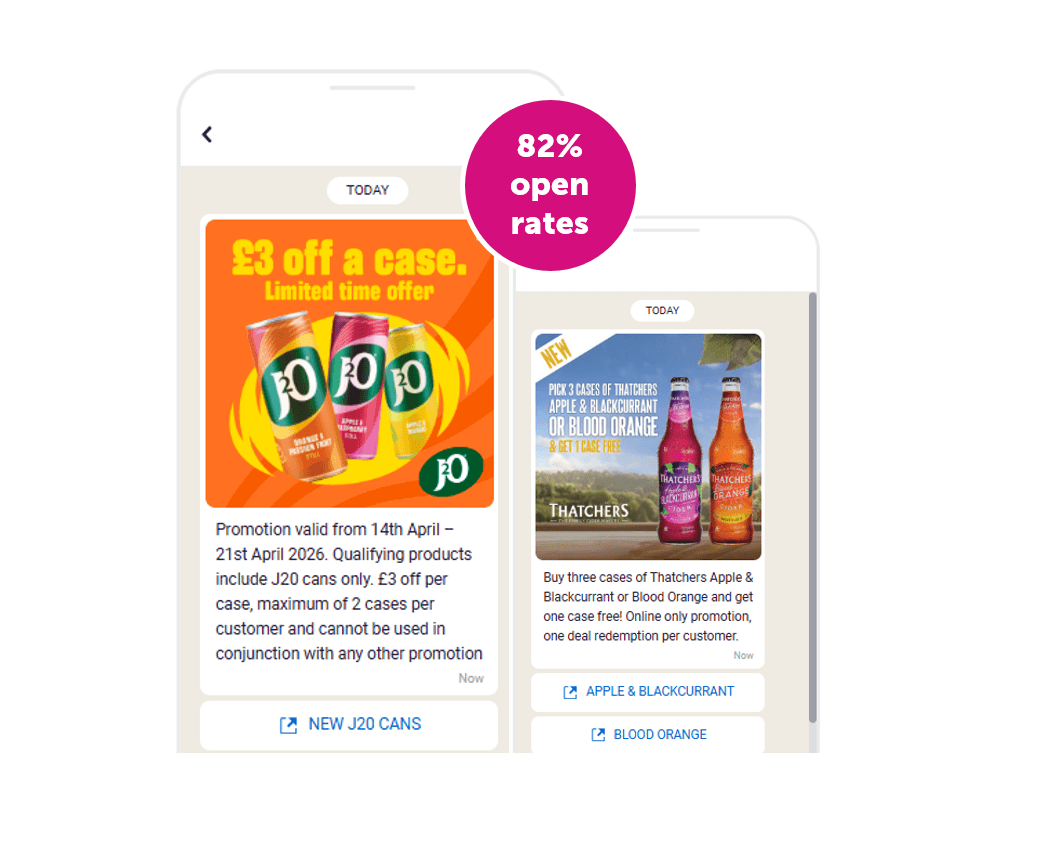
“Before WhatsApp, we relied heavily on telesales and email to reach our customers. With email engagement declining, it made sense to diversify, and WhatsApp was the obvious next step. If you want to make sure your message is actually seen, add WhatsApp to the mix. Every customer has different preferences, and covering more channels means more of them hear from you.”
– Anonymous, UK pub chain
What this means for you
This shows what’s possible when you’re willing to rethink your channel mix. For this brand, email engagement was slipping, and telesales alone wasn’t enough – so the team brought WhatsApp in to fill the gap, not as a replacement, but as another route to reach its customers.
Where WhatsApp is working right now
Across very different industries and use cases, one pattern stands out. Messages perform better when they appear in channels people already use and in formats that make them easy to read and respond to.
WhatsApp is becoming part of the marketing mix for more brands, and those using it now are already seeing stronger engagement rates and deeper connections with their customers.
