


What customer loyalty looks like, what customers really want from loyalty programs, and how to build one that works
Every marketer wants loyal customers. They’re the people who come back, spend more, and tell their friends about you. The tricky part isn’t knowing loyalty matters. It’s figuring out what actually earns it.
For a customer deciding which brand to shop with, charity to donate to, or service to subscribe to, the decision starts with the product, but ends with how the brand makes them feel. When a brand creates a journey that’s personal and frictionless, customers feel they’ve discovered a brand that cares about their entire experience, not just the conversion. That’s what makes a true brand advocate.
The tools and data marketers have access to today make building those experiences more achievable than ever. But as competition has increased, many brands have become focused on winning new customers and forgotten what happens next.
Those early touchpoints are important, of course, but it’s not the only thing marketing teams should be thinking about. It often means the early stages of the customer journey are smooth and effective, while the latter stages become more of an afterthought. Unfortunately, that’s where loyalty is won.
In this article, we’re sharing what customers really want from brands, including:
- What they look for when choosing new brands to shop with
- What kinds of loyalty programs and rewards do they want
- The real business impact a customer loyalty strategy can have on your bottom line
What customers actually want from brands
53% of customers consider loyalty programs to be“important” or“extremely important” to their future relationship with a brand
For Dotdigital’s Customer trend index 2026/27, we surveyed 4,000 consumers to find out what really inspired their loyalty to brands. Loyalty programs ranked fourth-highest as a driver, with 53% using them to determine whether they’d return to a brand.
62% of customers want a points-based loyalty program
Points-based reward systems are customers’ preferred type of loyalty program by some distance. Airlines, supermarkets, and credit cards have helped make them a familiar part of the customer journey, and the sense of progress customers feel when they reach a rewards threshold makes them as popular as ever.
Customers want free shipping (53%), cashback (52%), and gifts or samples (45%) from brands in exchange for their loyalty
Hard benefits like free shipping, cashback, and free products offer dual benefits: they reduce friction and add immediate value for shoppers. They give customers a good reason to keep coming back to the same brand rather than shopping around.
43% of customers want special moments like birthdays and anniversaries rewarded through loyalty programs
Loyalty programs should offer rewards that non-members simply can’t access, and a birthday reward is one of the most effective examples. In Dotdigital’s The loyalty divide report, we found that only 28% of marketers are collecting birthday data. That’s a big missed opportunity to make customers feel genuinely valued on one of the most personal days of the year.
Only 15% of customers consider the marketing messages they get to be“very relevant”
Building loyalty is easier when customers feel like the brands they shop with truly understand them. That means communicating in the moment, with personalization that goes beyond a first name in a subject line. Relevant marketing is speaking to what customers actually need and want, right now.
The loyalty divide continues across generations and locations
On average, Gen Z is most loyal to their three favorite brands
As the youngest generation in Dotdigital’s loyalty research, Gen Z is still deciding which brands deserve a place in their lives. That’s a real opportunity for marketers. Get the experience right, and you have a good shot at becoming one of the few brands they truly champion.
Baby Boomers (shoppers aged 60+) are loyal to 10 or more brands
On the other side, Baby Boomers have spent a lot of time (and money) finding the brands they trust. That loyalty, once earned, tends to stick. Convincing them to add your brand to the list takes effort, but it will pay off in the end.
59% of Millennials say loyalty programs are “important” or “extremely important” to their commitment to a brand
Millennials are the generation most motivated to shop with brands that offer loyalty programs. They’ve grown up seeing the value in earning air miles and paying less through membership pricing, making them the most engaged and consistent users of loyalty programs today.
54% of Gen X shoppers want free shipping and returns as a reward from loyalty programs
Gen X shoppers are practical, wanting rewards that offer immediate value and a smooth experience. Free shipping matters to them, but so does how a brand treats them when something goes wrong. Customer service is one of Gen X’s top loyalty drivers, which means the post-purchase experience is just as important as the reward itself.
62% of Gen Z prefer free gifts and samples as loyalty rewards
Gen Z wants rewards they can enjoy straight away. Free gifts and samples deliver exactly that, and for a generation that’s highly active on social media, receiving something physical also creates a natural opportunity to share, extending your brand’s reach beyond the loyalty program itself.
46% of US consumers have actively increased their spending to reach a loyalty reward
Nearly half of US shoppers have consciously increased their spending to reach a reward tier. That number rises to 65% among full-time workers and 72% among the highest income bracket. The customers most capable of driving your revenue are also the most motivated by loyalty programs.
43% of UK shoppers say that free shipping and returns are at the top of their loyalty rewards wishlist
When asked what they want more of from loyalty programs, UK shoppers said free shipping or returns (43%), freebie products and samples (42%), and birthday or anniversary rewards (37%) were at the top of their list. What’s consistent across the board is a preference for rewards that feel immediately useful or like they’re getting just as much as they’re giving to a brand.
47% of Singapore shoppers want personalized discounts from loyalty programs
Singapore’s appetite for personalization extends to the rewards customers want. At 47%, it’s well ahead of the US (36%) and the UK (33%), showing that a one-size-fits-all loyalty offer won’t cut it in this market. Programs that reflect individual purchase history will consistently outperform generic ones.
72% of Australian shoppers rate product quality as the loyalty driver
Product quality is the foundation of customer loyalty. But the two things right behind it are squarely within a marketer’s control. Customer service and loyalty programs both sit in the top three loyalty drivers for Australian shoppers, with 51% stating that loyalty programs are an essential reason to return.
What loyal customers are actually worth
It can cost 25x as much to acquire a new customer as to retain an existing one
Loyal customers spend more per order, buy more frequently, and refer other customers at no cost to you. None of that is new information, but it’s easy to lose sight of when acquisition feels more measurable and more exciting to talk about.
80% of future revenue typically comes from just 20% of existing customers
If a fifth of your customer base is generating the majority of your revenue, marketers’ focus shouldn’t just be on finding more customers; it should include how you move more of your existing ones into that top 20%. Tier progression, points multipliers, and rewards that grow over time give customers a clear path from being an occasional buyer to a high-value regular.
It’s 5x more likely that a loyal customer refers a friend to your brand
Referrals from loyal customers don’t just cost less than paid acquisition; they also convert better and stay longer. Someone who finds a brand through a friend already arrives with a level of trust that no ad can manufacture. And, unlike a paid channel you switch off when budgets tighten, loyal customers keep referring without any ongoing costs.
Recommendations from family and friends are now 45% more influential than they were 12 months ago
Word of mouth is now the fastest-growing driver of brand discovery, outpacing AI and search. Loyal customers are your most credible source, so building a refer-a-friend feature into your loyalty program turns word of mouth into a repeatable, measurable acquisition channel.
On average, loyalty program members spend 67% more than non-members
Members spend more because every purchase feels like progress toward something, like a points balance inching toward a reward or a tier being within reach. That sustained momentum is what separates loyalty from a discount: a discount has an end date, while loyalty doesn’t.
Over the last 12 months, 45% of shoppers spent more to reach the next tier of their loyalty program
Nearly half of shoppers have changed their spending behavior as a result of a loyalty program. They’re choosing one brand over a competitor, adding another item to their basket, or coming back sooner than they otherwise would have. That’s the power of a loyalty program; it doesn’t just reward loyalty, it creates the conditions to inspire more of it.
The business impact of a good loyalty strategy
Customer loyalty isn’t about giving blanket discounts and hoping people shop with you again. Your finance team won’t thank you for that approach, and it won’t build the kind of customer relationships that deliver the numbers above.
Loyalty works best as a multi-layered strategy that incentivizes customers in different ways, based on what they actually do. When loyalty rewards are tied to specific customer actions, the impact on your business is real and measurable.
In practice, this looks like:
Increased purchase frequency
When customers are working toward a reward, they come back more often. A customer who’s visited your store twice and earned points both times has a reason to make that third visit, especially if a reward is within reach. Over time, those extra visits add up to a lot more revenue.
Higher average order value
Points multipliers on specific products or collections, minimum spend thresholds, and the pull of tier progression all give customers a reason to add more to their basket. Someone who was going to spend $45 will round up to $50 if it means hitting the next tier or unlocking a reward like free shipping.
Lower churn
Customers actively earning points are harder to lose. Their accumulated points balance and tier status become a switching cost that competitors have to work against. A customer who’s only a few points away from ‘Gold’ status isn’t going to a competitor for one purchase.
More brand advocates
Loyal customers bring in new ones through conversations with friends and sharing on social media. Referrals from loyal customers typically convert better than paid acquisition and tend to stick around longer, too.
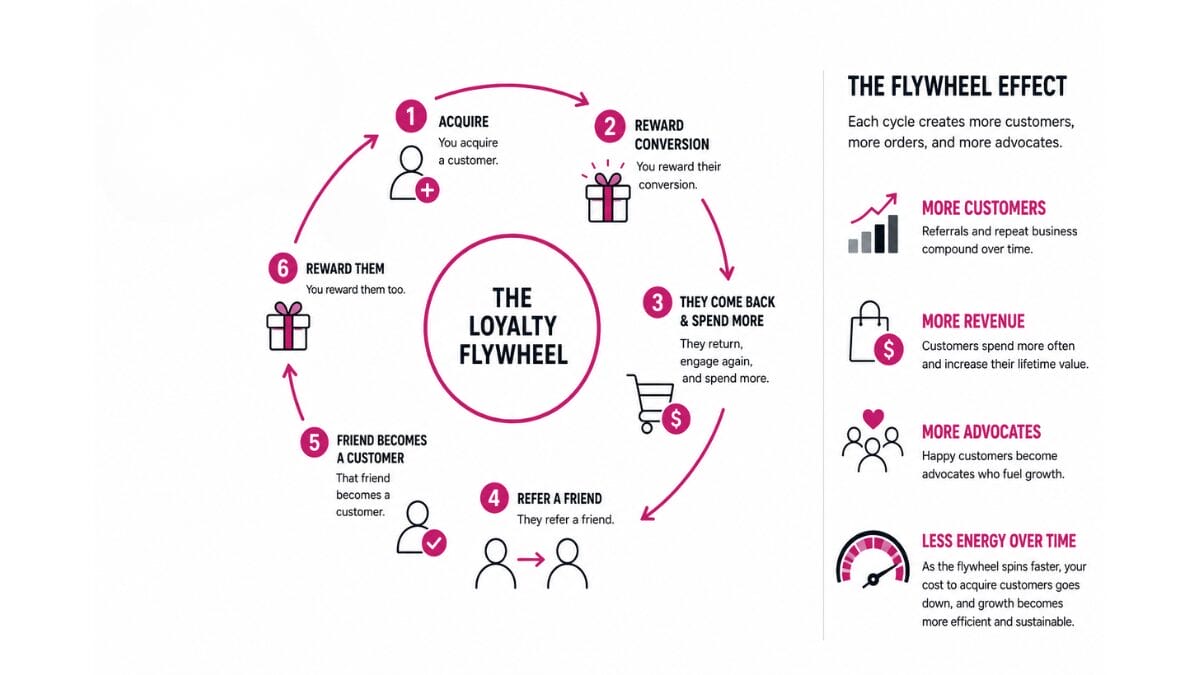
Think of loyalty like a flywheel. A customer finds you, you reward their conversion, they come back, spend more, and refer a friend. That friend becomes a customer, you reward them too, and on and on it goes. The flywheel keeps spinning, and over time, your loyal customers do a lot of the hard work for you. That’s the real business impact of a loyalty program, and that’s why the brands that invest in a loyalty strategy grow more efficiently over time.
If you’re thinking about what that could look like for your brand, Dotdigital Loyalty is coming soon. Register your interest and be the first to know when it’s ready.
