



What are US marketers prioritizing in 2026?
We asked 500 US marketers to share what they’re really thinking – not what they say out loud in board meetings or post on LinkedIn, but their true, honest thoughts, wins, and struggles for our Secret lives of marketers report.
The results show that increasing sales and revenue, improving brand awareness, and growing marketing databases are among the biggest priorities for US marketers. At the same time, they’re navigating fast-moving industry changes, new AI tools, and the ongoing pressure to show marketing’s impact.
Let’s take a look at what US marketers are focusing on, what’s getting in their way, and how they’re feeling about the future.
This is how we did it
We surveyed 500 US marketers aged 18+ between May 20 and June 1, 2026, and Censuswide conducted the survey.
Key findings
If you’re short on time, here are the key findings you need to know about US marketers.
1. Email and mobile are delivering the best returns
US marketers are split between email/CRM and mobile marketing when it comes to the channels delivering the highest ROI, even though email ranks fifth among their current channel priorities.
2. US marketing teams are mostly small
47% of US marketers are the sole marketer for their business, while a further 28% work in a team of 2-4.
3. Keeping up with customer behavior is the biggest challenge
28% of US marketers say keeping up with changing customer behavior is one of their biggest challenges.
4. AI is speeding up marketing work
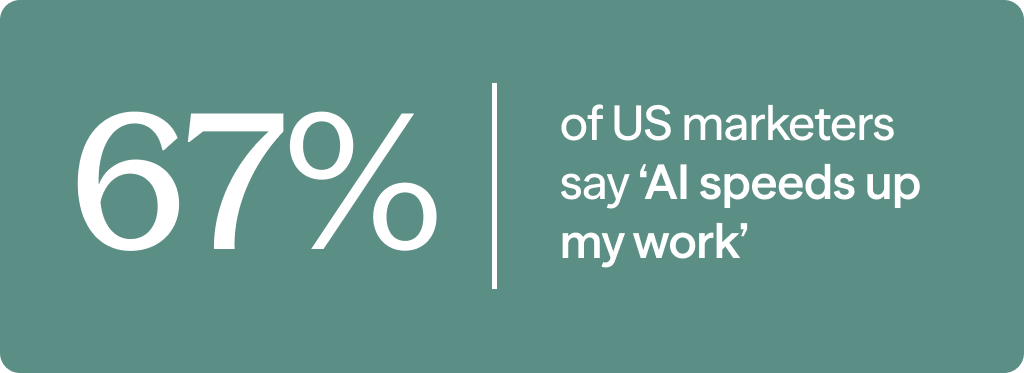
67% of US marketers say AI speeds up their work, while 37% say it makes their job easier and 38% say they enjoy using it.
5. US marketers feel secure in their roles
97% of US marketers feel secure in their current role, the highest of the three markets we surveyed.
How are US marketers set up for success?
Let’s look at team sizes, budgets, and ways of working.
Team sizes
US marketing teams are often small, with almost half of marketers (47%) working as the sole marketer for their business. A further 28% are in a team of 2-4, while 23% work in teams of 5-10.
- Team of one: 47%
- Team of 2-4: 28%
- Team of 5-10: 23%
- Team of 10+: 1%
With almost half of US marketers working solo, there’s a lot riding on one person’s ability to juggle priorities, deliver results, and keep up with what’s changing. If that’s you, don’t worry, you haven’t got to figure it out alone! Keep reading to get a clear picture of what other marketers are prioritizing this year.
US marketing budgets
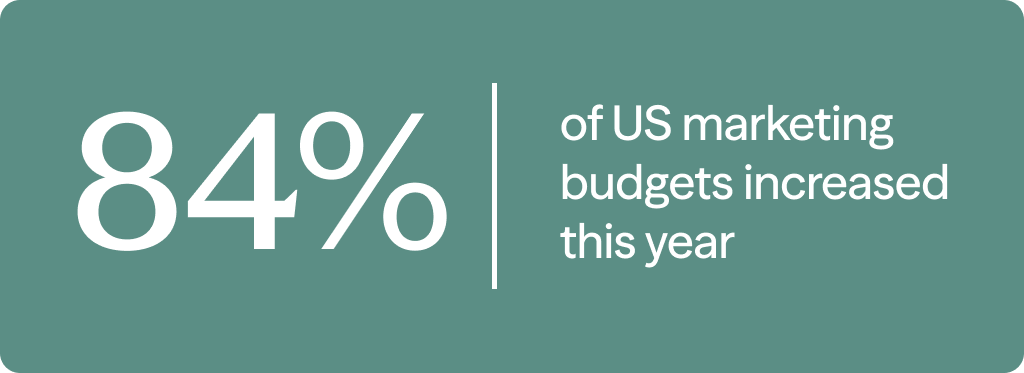
Last year’s survey showed how marketing budgets varied across our three markets. This year, we asked marketers whether their budgets had changed over the past 12 months – and the answer was pretty positive in the US.
84% of US marketing budgets increased this year, and 89% of US marketers expect their budget to increase again next year.
The budget changes for US marketers were split like this:
- 34% saw a budget increase of less than 10%
- 49% saw a budget increase of 10-24%
- 14% saw their budget stay the same
- 2% saw a budget decrease
So, while marketing teams are still pretty lean, budgets are moving in the right direction. Which leads us on to how marketers are working with fewer people, and the tools helping them do that.
How are US marketers using AI?
AI is now basically universal among US marketers. 99.6% say they’re currently using AI in their marketing role, with just 0.4% saying they aren’t.
So, of those marketers using it, how are they finding it?
- 67% of US marketers say ‘AI speeds up my work’
- 38% say ‘I enjoy using AI’
- 37% say ‘AI makes my job easier’
- 38% say ‘AI helps me be creative’
The numbers suggest AI is making a noticeable difference for many US marketers, particularly when it comes to getting work done faster. But there’s still a gap between using AI and feeling that it genuinely improves the job. Despite almost 100% of US marketers using AI, around a third say it makes their job easier or helps them be more creative.
Do US marketers trust AI?
When it comes to trust, 96% of US marketers trust AI outputs to some degree. But, as ever, there’s a little more to the story:
- 53% of US marketers fully trust AI outputs
- 43% trust them but always fact-check
And when we asked US marketers what they spend the most time fact-checking or editing, 25% said statistics and research.
AI can help take some of the legwork out of marketing, but someone still needs to decide whether the output is accurate, useful, and right for the audience. That human judgment is still very much part of the job.
What’s the LLM of choice for US marketers?
When it comes to their preferred LLM (large language model), ChatGPT comes out on top.
US marketers’ top three preferred LLMs:
- ChatGPT: 34%
- Gemini: 23%
- Copilot: 14%
Where are US marketers focusing?

The top five focuses for US marketers are:
- Increasing sales/revenue from marketing, 30%
- Improving brand awareness and identity, 30%
- Growing marketing contacts database, 30%
- Creating more engaging content (including video), 27%
- Improving internal stakeholder relationships, 27%
When it comes to the channels that US marketers are prioritizing to hit these goals, they are:
- Website personalization: 33%
- Events and webinars: 29%
- Mobile (SMS, MMS, WhatsApp): 29%
- Content marketing (blogs, video, guides): 29%
- Email: 26%
If website personalization is something you’re focusing on, check out how Dotdigital can help here.
Which marketing channel has the highest ROI in the US?

Email/CRM and mobile marketing are tied at the top, while organic and content marketing isn’t far behind.
US marketers’ top five channels for ROI:
- Email/CRM marketing: 17.4%
- Mobile marketing: 17.4%
- Organic/content marketing: 17.2%
- Paid social: 14%
- App push notifications: 13%
US marketers have the closest alignment between channel priority and the channels that bring in high ROI. In both the UK and Australia for example, email is top for ROI, but doesn’t even make the top ten list for channel focus.
What are the biggest challenges for US marketers?
Here are the five biggest challenges for US marketers, with some advice on how to deal with them if you’re facing them too.
1. 28% struggle to keep up with changing customer behavior
Use customer behavioral data, like browsing and purchase history, to spot shifts early and adjust your segments so that your audience is always getting relevant messaging.
2. 27% struggle with managing data privacy and compliance
Data privacy is one of those jobs that’s easy to put off until it becomes urgent. Look for tools with built-in privacy and compliance features that make it easier to manage permissions and keep customer data protected.
3. 27% struggle to prove marketing’s impact to the wider business
Being able to connect marketing activity to revenue makes those conversations much easier. Look for tools and reporting that give you a clear view of customer journeys and revenue attribution.
4. 25% struggle to get audiences to engage with their content
Creating relevant content is a great way to boost engagement, so use personalization to make each campaign feel as relevant as possible to the individual. And as AI-generated content continues to fill people’s feeds, make sure yours has something different to offer: unique, genuinely valuable content, ideally backed by exclusive data, just like this blog!
5. 25% struggle to keep up with new tools and ways of working, including AI
Using new tools can take a little time to get a handle on. If you’re a Dotdigital user, be sure to check out the Dotdigital Academy for regular new courses to get the most from our platform.
How can marketing leaders support their teams?
These challenges are pretty evenly spread, so there’s no single quick fix. But many of them come back to change: evolving customer expectations, new tools, new regulations, and new ways of working. Give your team the space to adapt, try new things, and build the skills they need to keep up.
And while the day-to-day challenges are one thing, there’s another question marketers are asking: do I actually want to stay in the industry?
How are US marketers feeling about their career and industry?
Here at Dotdigital, we’re all about marketing made human, so this year we wanted to delve into the human feelings of working in marketing, including the challenges, hopes, and realities.
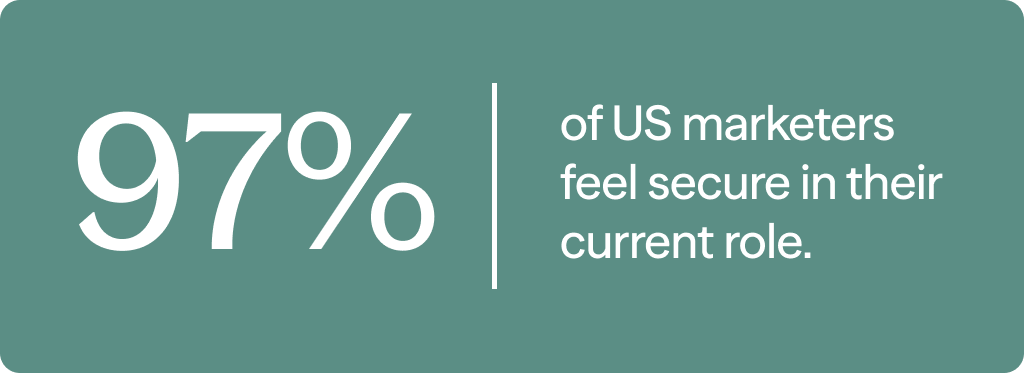
97% of US marketers feel secure in their current role, the highest of the three markets we surveyed. Feeling secure in a job is one thing; feeling fulfilled by it is another.
Most US marketers (57%) plan to stay in marketing in some way, but a high number are considering leaving the industry altogether.
A snapshot of US marketers’ career sentiment
- 34% of US marketers say they plan to stay in marketing long-term
- 23% plan to stay in marketing, but change specialism
- 10% are open to leaving
- 17% are actively considering leaving
- 14% plan to leave marketing within 12 months
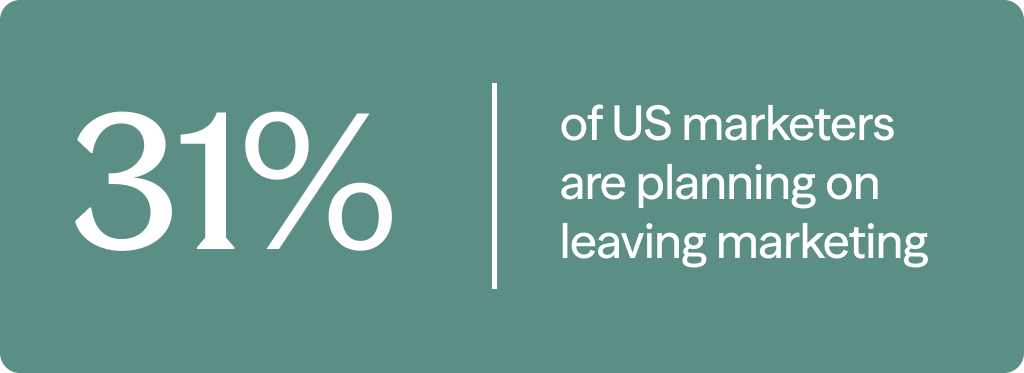
Among those considering leaving, 27% say the reason is better opportunities elsewhere, 20% say it’s because of a lack of fulfillment or enjoyment, and 19% cite workload and burnout.
What this means for you
US marketers are feeling confident about what’s ahead
81% of US marketers are optimistic they’ll hit their goals this year, with a further 12% feeling neutral. And with 84% seeing their marketing budget increase over the past year, there’s more room to put those plans into action.
So, what next steps can you take from this data?
Look at the channels already delivering
Email/CRM and mobile marketing are tied for the highest ROI among US marketers, but email ranks fifth among their current channel priorities. There could be an opportunity to look at where your strongest returns are coming from and check whether your investment reflects that.
Keep the human in the loop
AI is clearly part of marketing’s everyday toolkit, with virtually every US marketer now using it. But even with 99% using it, the number of marketers who ‘enjoy’ it or feel it speeds up their work is a lot lower. This indicates a need to keep humans in the loop and be considerate with AI initiatives to make sure it makes sense for productivity and job satisfaction.
If you want to hear a cautionary tale (and have a good laugh), check out our marketing AI fails blog to see what went wrong and how to avoid the same pitfalls.
Don’t overlook the people behind the marketing
US marketers are feeling pretty secure, with 97% saying they feel secure in their current role. But 17% are actively considering leaving the industry, and another 14% plan to leave within the next 12 months.
For marketing leaders, that’s a reminder that keeping talented people engaged matters just as much as keeping up with the latest tools.
Want to see the full picture?
These are just some of the findings from The secret lives of marketers report. Read the full report to see how US marketers compare with their UK and Australian peers, and explore what the data reveals about AI, budgets, career confidence, marketing priorities, and the challenges facing teams today.
