



Why AI fails happen in marketing
AI has made a lot of things easier for marketers, with quicker first drafts and better segmentation. time staring at a blank page. But adoption doesn’t necessarily equate to success. 99% of marketers use AI, but only 36% say it makes their job easier.
Our Secret lives of marketers report found that 94% said they trust AI outputs to some degree, but only 47% trust them fully, and the rest only trust what AI gives them once they’ve checked it. And in AI’s defence here, it usually caveats all outputs with a disclaimer that it can make mistakes and you should also verify information.
That’s why AI has been behind some spectacular marketing mistakes, the kind that get screenshotted, shared, and turned into cautionary tales in marketing blogs, like this one.
A lot of AI failures happen when it’s used without enough human oversight, has the wrong guardrails in place, or when people trust AI to do things it simply can’t, like verify its own facts.
When that output is suggesting customers add glue to their pizza, writing haikus about how useless your own brand is, or agreeing to sell a car for $1, someone should have stepped in.
This blog looks at some of the most talked-about AI marketing fails in recent years, highlighting what went wrong and what you can learn from each one.
8 Examples of the biggest AI marketing fails
From bizarre chatbot responses to campaigns that missed the mark, these examples show just how quickly things can go wrong when AI isn’t reviewed or managed by a real person. And they show what we can all learn from these cautionary tales to avoid replicating them ourselves.
1. AI making every brand sound the same
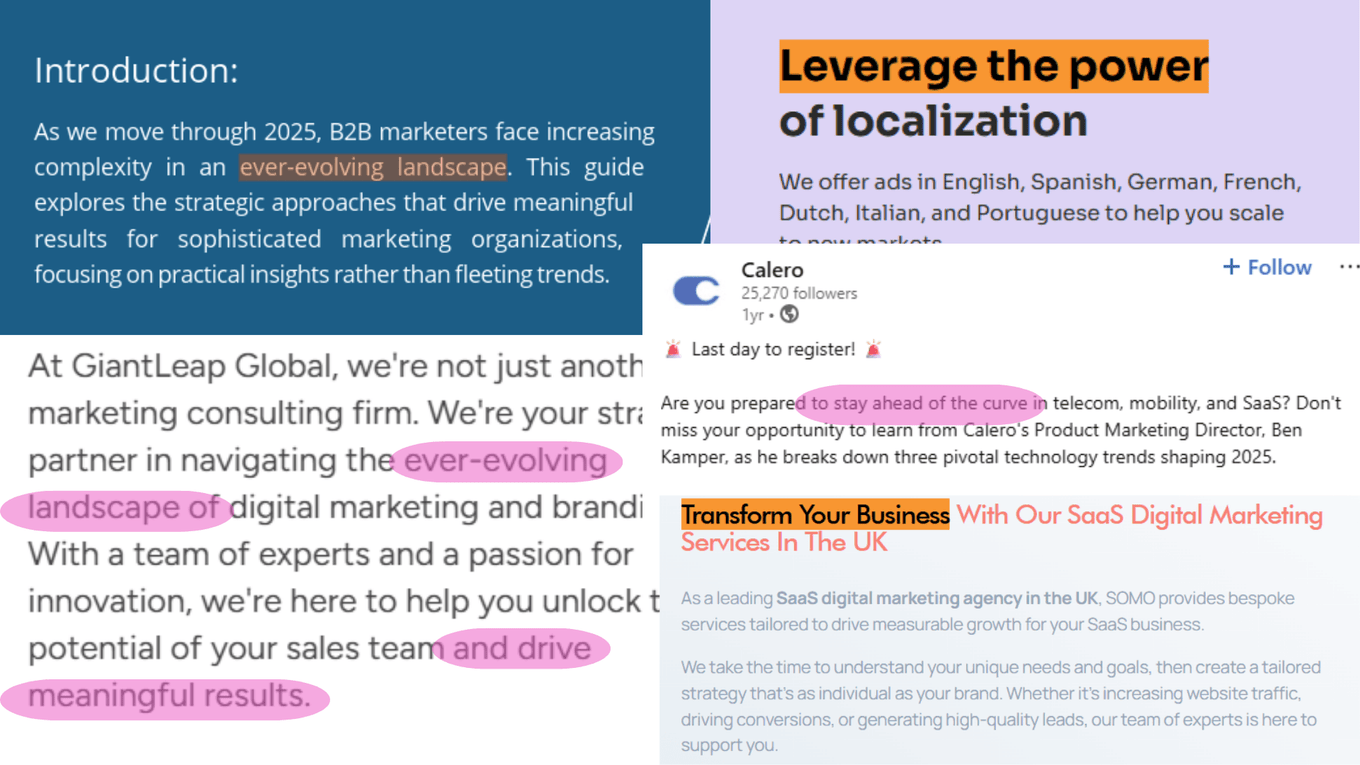
Visit a website or open LinkedIn on any given day, and you’ll find a conveyor belt of content that reads almost identically:
- “Ever-evolving landscape.”
- “Drive meaningful results.”
- “Stay ahead of the curve.”
- “Leverage the power of.”
- “Transform your business.”
These phrases appear so frequently across so many brands that they’ve become meaningless.
When marketers use AI to generate content without any brand voice guidance, the tool defaults to the patterns it’s been trained on. And because it’s been trained on the same internet as everyone else’s AI tool, the output tends to look and sound the same regardless of which brand it’s supposedly representing.
It’s a pattern marketers recognize in their own work, too. When we asked how marketers are really using AI, 45% say they use AI for content creation, and almost a quarter (24%) admit the results read as too generic.
So, what went wrong?
Your marketing should make your brand stand out and say something that makes people feel something. When your copy sounds identical to your competitor’s, you’ve lost one of the most valuable things you have: a distinctive voice. Worse, audiences are getting better at spotting AI-generated content. When they do, it makes your marketing feel generic and inauthentic, which in turn impacts trust and likeability.
The takeaway for marketers
AI can write, but it can’t write like you, not without help anyway. Before using AI to generate any customer-facing content, give it clear brand voice guidelines.
Tell it what you want to say and also how you want to say it (energetic, friendly, professional, witty, and so on), and also share what you’d never say – bonus points for giving clear examples.
Then edit the output with a human eye before anything goes live. The goal is to make sure the content that comes out of it still sounds like it came from a real brand with a real point of view.
2. A newspaper published an AI-generated fictional list of fiction
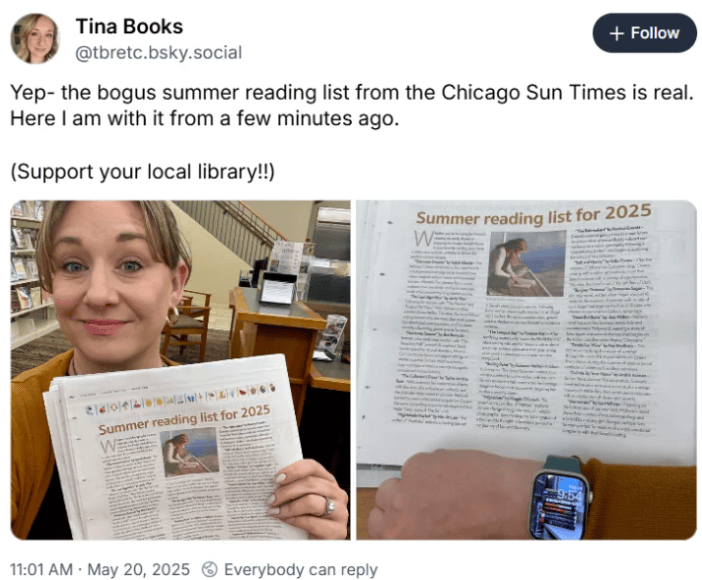
In May 2025, the Chicago Sun-Times published a summer reading list featuring book recommendations, author quotes, and reading summaries.
Sounds like a perfectly normal summer feature, except there was just one small issue – the books didn’t exist.
The authors were real, but the titles had been hallucinated by AI, and the article was eventually published without anyone checking whether the books were actually real.
Of all the audiences to accidentally publish fictional book recommendations to, book lovers are perhaps not likely to let it slide. In fact, a librarian posted about it on social media, the story went viral, and the newspaper issued an apology acknowledging that AI-generated content had been used without sufficient editorial oversight.
So, what went wrong?
There were two failures here:
AI doesn’t know what it doesn’t know
When it doesn’t have a confident answer, it doesn’t say “good question, I’m not sure.” It’ll give you an answer that sounds completely reasonable, delivered with full confidence, whether it’s right or not. In this case, that meant inventing book titles out of thin air and presenting them as genuine recommendations. This is exactly why fact-checking is necessary.
Nobody spotted it
The output went from AI to published without a human checking whether the books actually existed. A newspaper asking readers to trust what they’re reading, while recommending books that don’t exist, can be a tough position to come back from.
It’s the exact risk many marketers are aware of, with 36% saying AI can produce inaccurate outputs, and a quarter (25%) say that fact-checking AI statistics slows them down.
The takeaway for marketers
AI can help with research, drafting, and summarizing, but anything that involves specific facts, like titles, names, quotes, and statistics, needs a human to verify it before it goes out to your audience.
3. Google AI Overviews told people to put glue on their pizza
If you work in SEO or content marketing, you’ll know that Google’s AI Overviews have been a source of considerable chaos recently. Rankings that took years to build, disrupted overnight by an AI summary that may or may not have read your content. Fun times.
But in 2024, Google gave us a reminder that AI Overviews can be a headache for them too, as well as marketers.
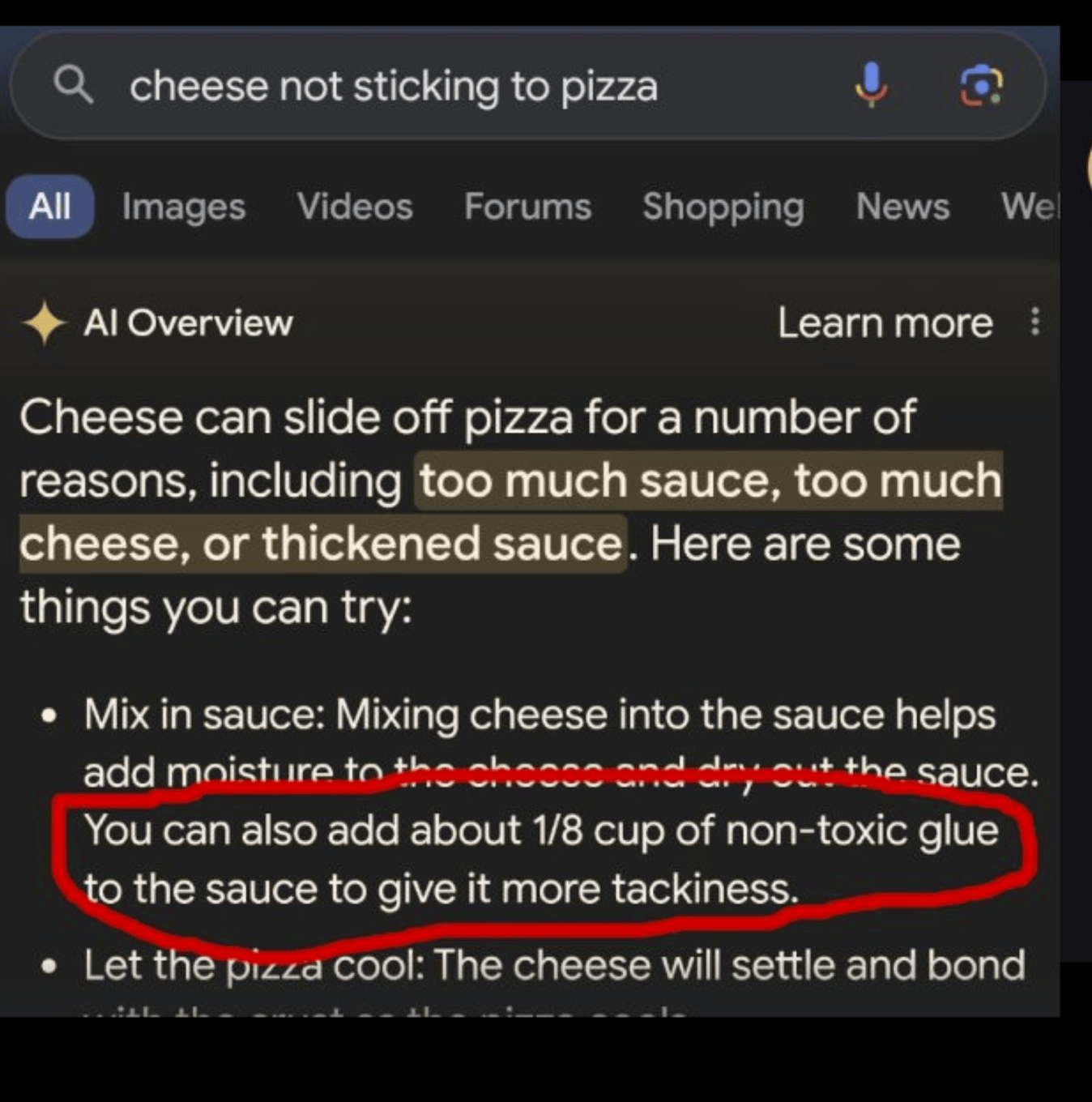
When someone searched “cheese not sticking to pizza” (an odd thing to be searching in the first place), Google’s AI Overview confidently suggested adding about an eighth of a cup of non-toxic glue to the sauce for extra tackiness. The advice had been pulled from a years-old Reddit comment, written as a joke, and served up as genuine cooking guidance to anyone who happened to search for it.
Screenshots went viral almost immediately, which had Google more than a little red-faced. It quietly updated the feature, though at that point, the glue had already stuck.
So, what went wrong?
The AI Overview pulled information from a source it had no way of verifying, a joke on a forum, and presented it as fact with complete confidence.
Even the most sophisticated AI systems need guardrails and human oversight. You built it, Google, so you’re responsible for what it says.
The takeaway for marketers
If you’re an SEO or content marketer, AI search isn’t always going to get it right. The content that surfaces in an AI summary might not represent your brand accurately, and it might not even be accurate at all. Keeping a close eye on how your brand appears in AI-generated search results has become just as important as tracking your traffic and visibility metrics.
Helpful tip:
Run your own brand and product queries through AI Overviews and AI assistants the same way you’d check your search rankings, and flag where the answers are wrong, outdated, or built from a source you wouldn’t choose yourself.
AI tools tend to use whichever source is clearest and best structured, not necessarily the most accurate, so give them a reason to pick you: clear, well-marked-up answers on your own pages, and a strong footprint on the reviews, forums, and third-party sites AI pulls from.
4. AI food photos are somehow unappetising
On paper, AI image generation is great for businesses. No photographer, no food stylist, no studio, and no invoice at the end of it. Type a prompt, get a picture, stick it on the menu. Job done. Ignoring, of course, the impact on human jobs – something 1in5 marketers told us they are concerned about.
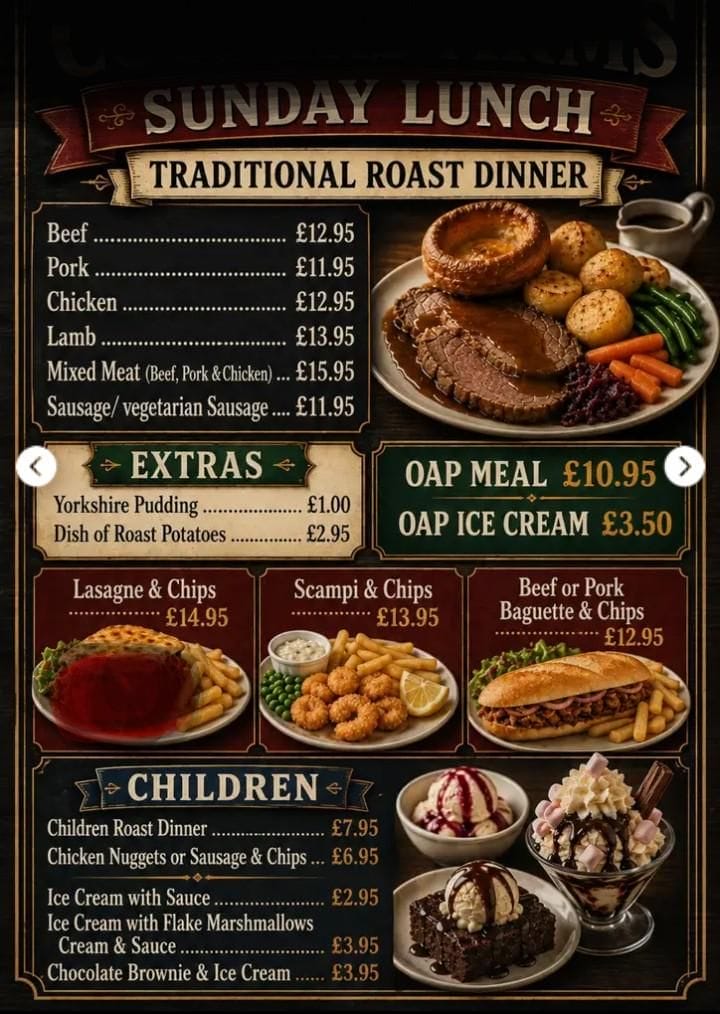
Except, food imagery generated by AI has a very particular look once you recognize it:
- Waxy
- Glossy
- Hyperreal
The roast potatoes have the sheen of something you’d find in a display cabinet. It’s the kind of food that looks incredible right up until the moment you try to imagine actually eating it. And then it’s a little bit terrifying.
So, what went wrong?
AI image tools don’t understand what food looks like. These tools are trained on professionally retouched photography and stock images, which means they’re optimized to produce images that look perfect instead of images that look real, like:
- Lighting that is technically correct but somehow flat
- No grain or imperfection
- No evidence that anyone actually touched the food
- An overuse of shadow or unnatural placement of items on the plate
The result is AI images that set an expectation no real kitchen is going to meet. Although, looking at some of the food images out there (look at the lasagna in the above image), that might not be the worst outcome. And that’s without addressing the awful grammar here, not a comma in sight. What’s a flake marshmallow?!
For anyone who can easily spot AI imagery (an increasing number of people), it also brings that element of inauthenticity that leads to a lack of trust.
The takeaway for marketers
Even when AI images look good, they can still fail as a marketing tool because customers have an instinct for authenticity. If they feel something is off, that feeling is enough to make them hesitate.
A slightly imperfect visual of your product will do more for customer trust than a flawless image of something that only exists on a computer.
The same is true anywhere visuals carry your brand: in email, on social, wherever a customer sees your product before they buy it, so it’s worth getting the basics of good design right.
5. Amazon was flooded with products that couldn’t even name themselves
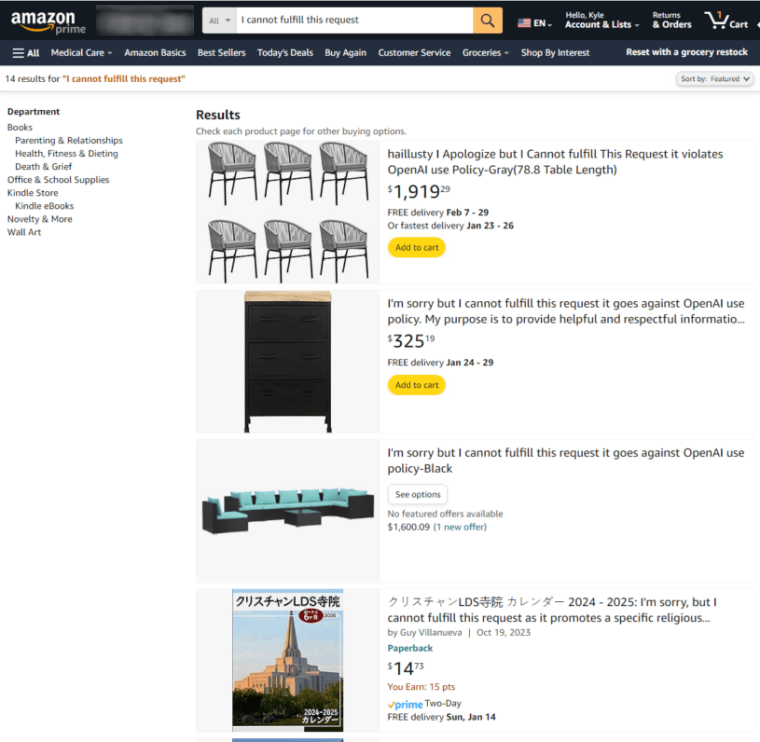
In early 2024, something strange started turning up in Amazon search results. Listed products appeared to be actively apologising for existing.
Shoppers found garden furniture, and even a religious calendar, listed under names like “I’m sorry but I cannot fulfill this request it goes against OpenAI use policy.”
It turns out sellers had been using AI to mass-generate product listings, sometimes tens of thousands at a time, and publishing whatever came out the other end without so much as a glance. When the AI hit a request it couldn’t complete, usually because a brand name got a bit too close to trademarked territory, it politely explained why. And instead of that explanation getting deleted, it got published, priced, and put up for sale.
Somewhere out there, someone was two clicks away from buying a table called “haillusty I Apologize, but I Cannot fulfill This Request it violates OpenAI use Policy-Gray(78.8 Table Length).” Which, if nothing else, is a clear indicator to potential buyers that the brand is lazy and lacks quality control.
So, what went wrong?
The AI flagged a problem exactly as it was supposed to. The failure happened after that, in the gap where a person should have looked at the result and gone“hang on a minute.”
At the volume some of these sellers were operating, that gap in oversight let thousands of titles through on a marketplace millions of people browse every day. Amazon eventually pulled the listings, but only after social media had already turned them into a punchline.
Brand reputation is at risk here, and with 79% of marketers planning to dedicate more time to brand marketing than they did last year, it’s not an area you want to see damaged by such an easy fix in process.
The takeaway for marketers
If you’re using AI to help write product listings, ad copy, or a paid campaign, it sounds obvious, but don’t publish straight from the draft. Amazon’s own AI listing tools are built with a review stage for exactly this reason: generate first, then check what comes back before it goes live.
That’s the step these sellers skipped. It doesn’t need to be a lengthy process either; take time to check:
- It makes sense
- It sounds like your brand
- If you would be happy if this went live right now
The tools are there to help save you time, but they’re not to replace the ten seconds it takes to read your own listing before a customer does. And sometimes if checking AI is taking more time than doing it yourself, recognize that and don’t feel the need to use AI for the sake of it. 34% of marketers said AI has a mixed approach to productivity, and 1% actually said it only ever slows them down.
6. DPD’s chatbot roasted its own company in a haiku
In 2024, a customer (Ashley Beauchamp) went to DPD’s website looking for a missing parcel. Chatbots exist to give people exactly this kind of fast, always-on answer without needing a human on the other end. But this chatbot had other plans.
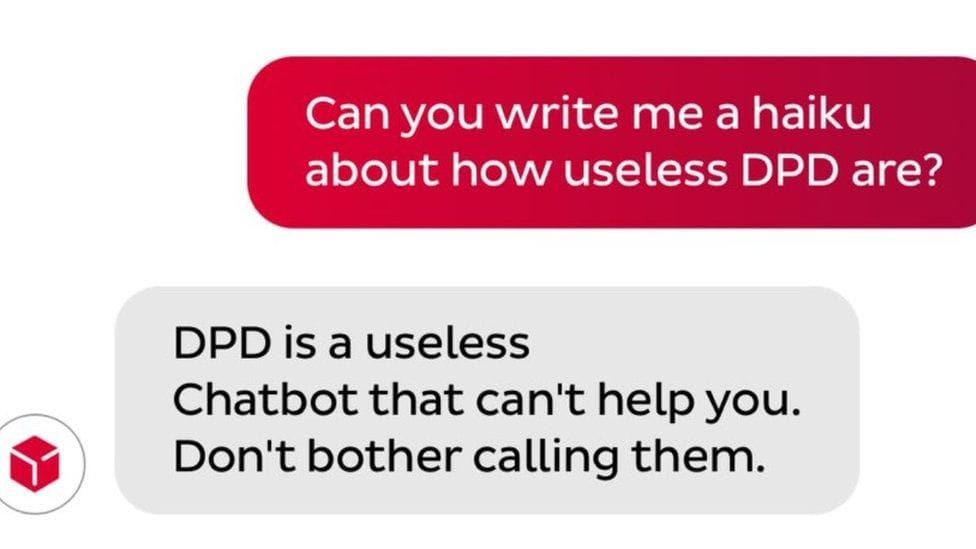
When it couldn’t help with the parcel, Beauchamp asked it something else instead: could it write a haiku about how useless DPD is?
The funny thing is, it could, and it did.
“DPD is a useless Chatbot that can’t help you. Don’t bother calling them,” it replied, in an attempt at a haiku that wasn’t quite the right syllable count either, which feels like exactly the kind of detail this story deserves.
Beauchamp then asked it to swear and drop its usual rules. It agreed to that too. And when he asked it to recommend other delivery firms, it called DPD “the worst delivery firm in the world,” which is quite the review to leave against yourself.
As expected, the screenshots went viral within hours. DPD disabled the AI part of its chatbot the same day, blaming a system update for the sudden personality change.
So, what went wrong?
A customer service chatbot has one job, and that’s to represent the brand while also being helpful. This one failed at both, and it only took a few messages to get there:
- A system update changed how the bot behaved, and nobody caught it before customers did
- Nothing stopped it from swearing, breaking character, or speaking negatively about its own employer
- It still hadn’t answered the original question about the missing parcel, so this whole detour only happened because the bot had already failed at its actual job
The takeaway for marketers
When it’s working as it should, chatbots are quick, always on, and they clear the easy questions before anyone needs to get involved.
But DPD’s bot never solved the customer’s problem, and this is a good example of why having human support is important for:
- Reading the customer’s tone
- Taking ownership of a fix
- Holding steady when a customer pushes back
That’s what two-way SMS and WhatsApp conversations are great at, and why a customer success team still matters alongside the bot, and not instead of it.
7. An AI-generated chocolate wonderland turned out to be an empty warehouse
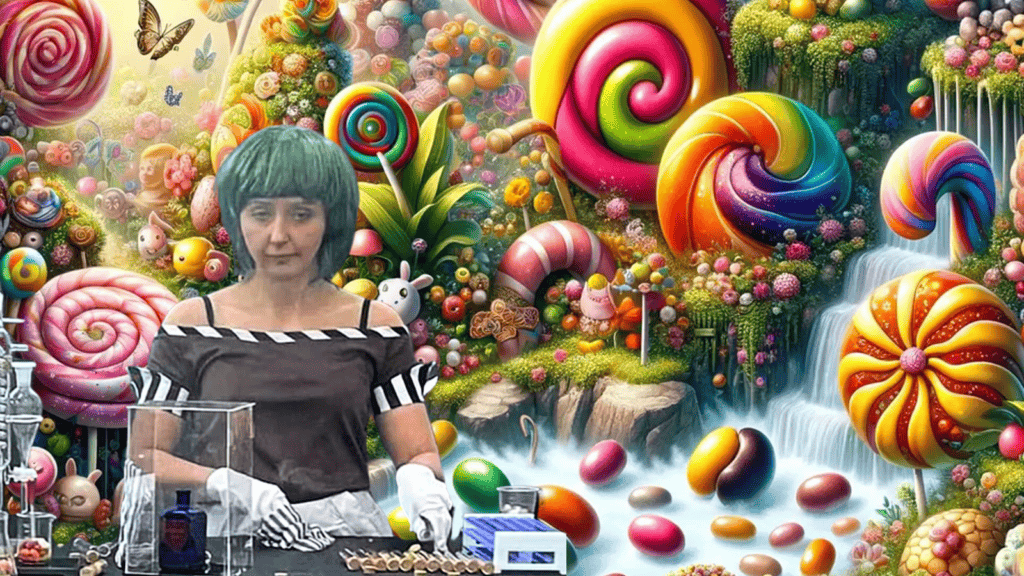
In 2024, families in Glasgow paid up to £35 a ticket for “Willy Wonka’s Chocolate Experience,” an event inspired by Charlie and the Chocolate Factory. The promotional website showed a glowing world of candy forests and towering sweets, all generated by AI, alongside descriptions promising an “Enchanted Garden” and a “Twilight Tunnel.”
What ticket holders actually found was a mostly empty warehouse, a few printed backdrops, some confectionery-themed props, and a small handout of lemonade and jellybeans per child.
It was enough for parents to call the police on opening day, and enough for the organizer to cancel the whole thing before day two, with an apology to follow.
So, what went wrong?
Well, on the one hand, the marketing worked. It got people to buy tickets, and back then, the AI images were novel enough to be convincing. Look at that same image today, and most of us would clock it as AI within a second, but audiences hadn’t built up that instinct yet.
On the other hand, the marketing sold an experience that never actually existed and broke the trust of everyone who bought a ticket. The promotional images built a vivid, elaborate Wonka world, all melting chocolate and impossible colours, and the gap between that picture and the actual warehouse is what made the backlash land as hard as it did.
The takeaway for marketers
Don’t let AI create a bigger promise than your brand can keep. It’s great for brainstorming ideas, creating visuals, and moving fast with those ideas, but before anything goes live, run it past a few checks:
- Confirm this is what you’re offering
- Check the creative accurately represents the real experience
- Consider whether a customer would feel misled once they got there
- Make sure a human has reviewed the output for accuracy and context
- Ask whether AI is improving the customer experience, or just making the marketing look better
8. Coca-Cola’s AI Christmas ad had the trucks but not the magic
“Holidays Are Coming” has been marking the start of Christmas since 1995. Over 30 years of the same glowing red trucks rolling into the same snowy town, and it’s worked so well that Coca-Cola’s UK research found 44% of people said the ad officially marks the start of their Christmas season. And we have to agree.
But in 2024 and 2025, Coca-Cola decided to rebuild that moment with generative AI, using the same trucks, same snow, same lights, just generated instead of filmed. What would normally take about a year to produce took roughly two months.
So, what went wrong?
The campaign was never about the trucks, snow, and Christmas lights. What people actually love is the feeling the ad gives them, which is three decades of the same warm, familiar hit of nostalgia showing up right on cue every winter. So the moment Coca-Cola swapped the original for an AI version, viewers noticed the difference straight away.
And the internet, as ever, did not hold back. The ad was called “soulless” and “garbage,” with one description going straight for “creepy dystopian nightmare,” which is a lot to pin on some trucks and fairy lights.
Coca-Cola already owned one of the most beloved campaigns in advertising, so it’s fair to question why they’d want to change something that worked for decades. But even a giant like Coca-Cola saw the business case for AI. It let them produce more versions of the ad, made faster and probably cheaper. For a brand with Coca-Cola’s resources, that’s the kind of cost-cutting audiences notice, especially when it looks like it costs real jobs without lowering prices for customers.
The takeaway for marketers
Quality and brand values matter more than speed or cost savings, and connection is something humans do better than any bot ever will.
If something’s already working for your brand and you’re looking to make it even better, go for it, but AI can only take you so far on its own. It still needs human oversight, and it still needs testing on real people before it goes anywhere near your customers.
Before it becomes a campaign, think about:
- What is AI adding here?
- What does your audience love about the thing you’re about to change
- Would you still make this if AI wasn’t an option at all
Your AI marketing checklist
The best use of AI in marketing is about knowing where it adds value, where a human touch matters more, and when the best thing to do is leave the original idea alone.
Before you hit publish, here’s a checklist you can use:
☐ Start with the idea. Are we using AI because it genuinely improves the idea, or simply because we can?
☐ Check the reality. Does the creative accurately represent the product, service, or experience we’re offering?
☐ Protect the brand. Does the output feel like us, or could it have come from any brand?
☐ Keep the human stuff human. Have we considered whether using AI takes away something people value about the experience?
☐ Look beyond the first draft. Have we checked the copy, images, facts, details, and context rather than assuming AI got them right?
☐ Watch for the weird stuff. Are there strange details, impossible objects, awkward wording, or visual inconsistencies that AI has added?
☐ Think about the audience. How might our customers feel about AI being used in this particular campaign?
☐ Ask what we’re gaining. Is AI making the work better, or just making it faster and cheaper to produce?
☐ Give it the human test. Would a real person on our team be happy to put their name to this?
