



Sometimes it feels like all marketers are hearing is that ad costs are rising, search visibility is getting harder, and getting AI to recommend or cite your brand should be your team’s number one focus. After all, how can you grow if potential customers can’t find you in the first place?
It’s a good question, but not the only one you should be asking. A better question would be, how can we grow more organically? Or how can we make our existing customers spend more? What can we do to keep customers coming back? The answer to all of these is simple: build a loyalty program.
Loyal customers spend more, buy more often, and bring new customers with them at no extra cost to you. There’s solid data supporting this, too:
- It can cost 25x as much to acquire a new customer as to retain an existing one
- 80% of future revenue typically comes from just 20% of existing customers
- It’s 5x more likely that a loyal customer refers a friend to your brand
- Recommendations from family and friends are now 45% more influential than they were 12 months ago
- On average, loyalty program members spend 67% more than non-members
- Over the last 12 months, 45% of shoppers spent more to reach the next tier of their loyalty program
We’ve got a full breakdown of the business impact of loyalty if you want to dig deeper into the numbers.
The case for having a loyalty program is strong, but knowing how to build one that actually delivers big numbers is harder. This article dives into the details. We’ll walk you through the earning rules you can build into your program, the business goals you can hit with a well-structured program, and five ready-to-use templates you can adapt to your brand.
What to reward and how to reward it
Trying to reward everything devalues your loyalty program and tells customers that you’re not quite sure what you’re trying to achieve. The most effective loyalty programs are built backward, starting with the goal you want to reach first.
Here’s a breakdown of the earning rules worth building into your program and the thinking behind each one.

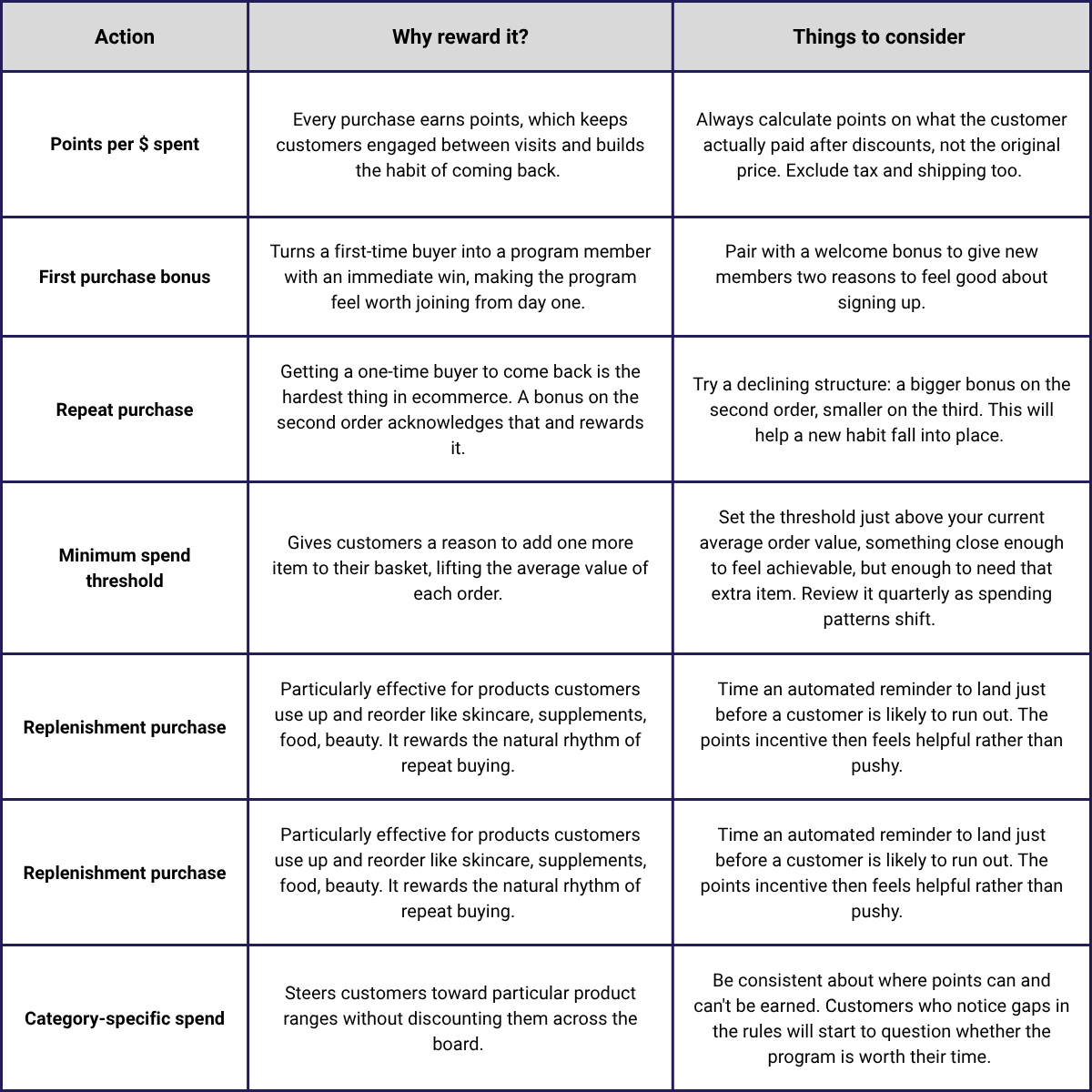
1. Rewarding customers for spending
This is the foundation of most loyalty programs. Spend-based rewards are easy for customers to understand, easy for marketers to communicate, and they reinforce the behavior that matters most – repeat purchases.

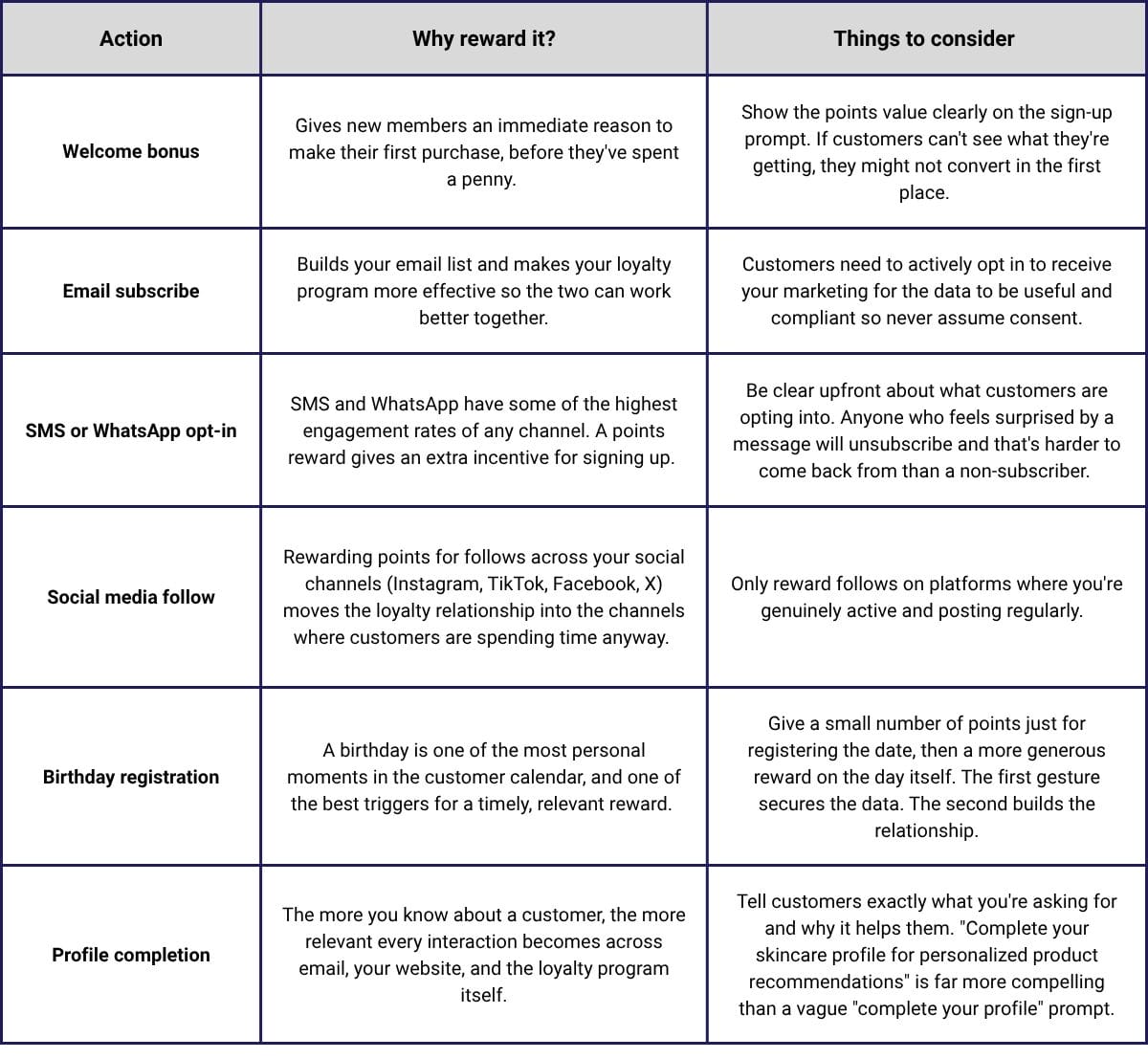
2. Rewarding customers for connecting with your brand

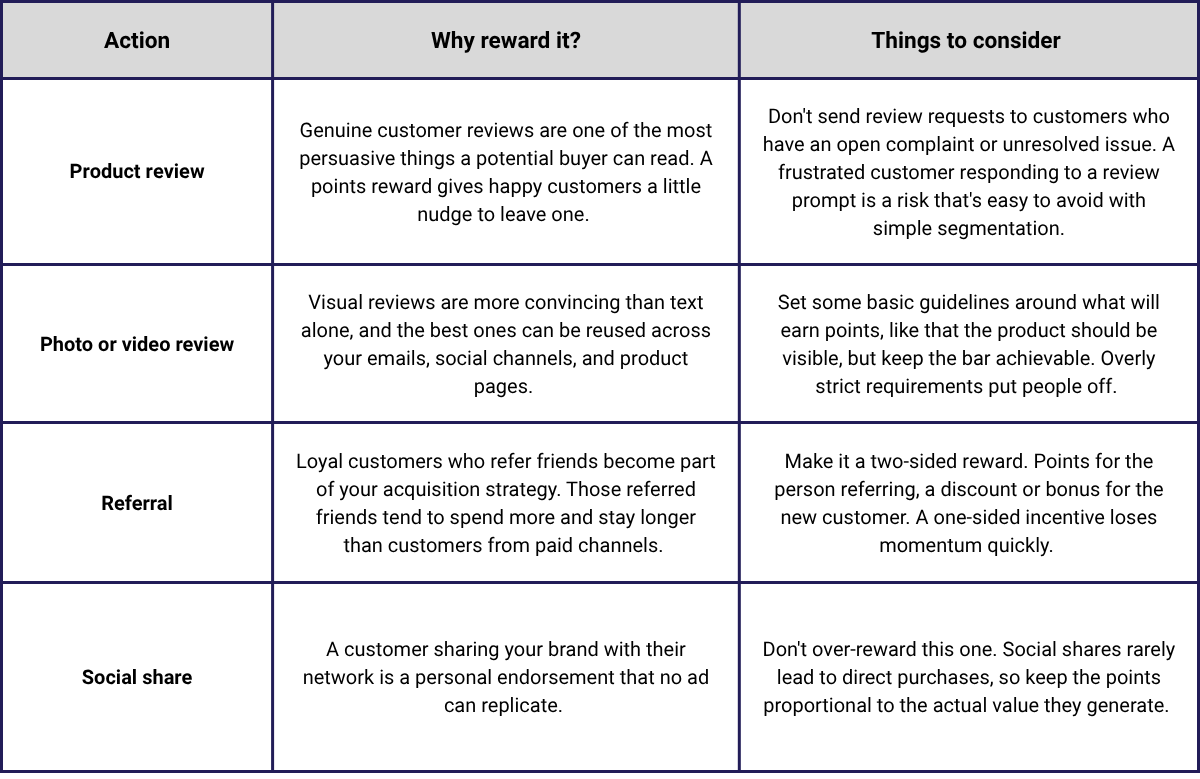
3. Rewarding customers for being advocates
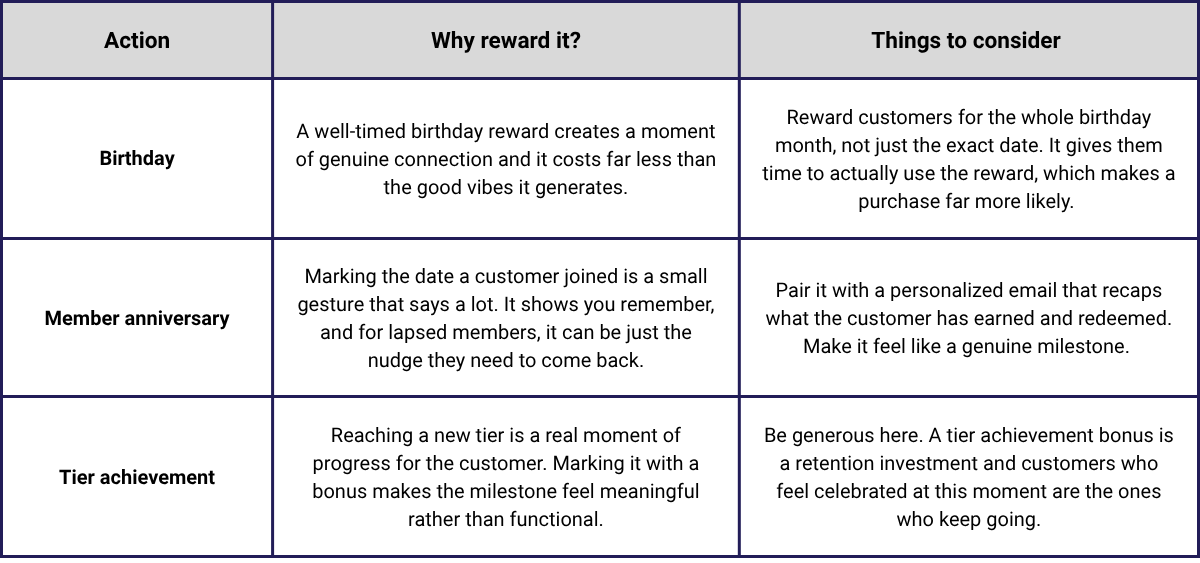
4. Rewarding your customers for time spent with your brand
Loyalty strategies for every business goal
Loyalty programs aren’t one-size-fits-all. The most effective ones are built around specific business objectives, rather than points for purchases. Here are seven ways you can tailor your loyalty strategy based on your team’s goals.
1. Increasing customer lifetime value
Customer lifetime value (CLV) is the total revenue a customer generates over their entire relationship with your brand. Your highest-value customers tend to share a few things in common: they buy regularly, they engage with your communications, and they feel a genuine connection to your brand. A loyalty program strengthens all three.
How to tailor your loyalty strategy to boost CLV
- Tier programs give customers a long-term reason to keep spending; the higher the tier, the better the benefits, which means every purchase feels like it’s building toward something
- Anniversary rewards sent on the date of a customer’s first purchase are a simple, personal way to reinforce the relationship and prompt a return visit
- Points multipliers on categories a customer already buys from make the program feel like it was built for them specifically, and that personal relevance keeps customers more engaged and more likely to come back
2. Reducing churn and re-engaging lapsed customers
Every brand has customers who go quiet. The question is whether they’ve moved on or just lost momentum. Loyalty programs give you a way to find out and a reason for lapsed customers to return that doesn’t rely on discounting.
How to adjust your loyalty strategy to cut churn
- Points expiry reminders let customers know their balance is about to disappear, creating urgency without giving anything extra away when they realize they have something to lose
- Win-back campaigns built on loyalty data let you reach lapsed customers with something personal (like a message that references their last tier, their points history, or the products they actually bought) rather than a generic voucher that could have gone to anyone
3. Increasing average order value (AOV)
Loyalty programs are one of the most effective tools for encouraging customers to spend a little more per visit without offering blanket discounts that reduce what you make on every sale.
How to tweak your loyalty strategy to increase AOV
- Spend thresholds tied to points multipliers, like “Spend $75 to earn double points this weekend,” work better than a flat promotion because it’s personal, clear, and time-bound
- Tier benefit ladders (where higher tiers unlock better rewards) give customers a long-term reason to spend more on every visit to get to the next tier to unlock 20% their next order
- Bonus points on specific products draw attention to higher-value items without reducing the price of those items directly
4. Improving conversion rate
A loyalty program gives you something extra to show customers at the moments they’re most likely to hesitate. Sometimes that’s all it takes to tip them toward completing a purchase.
How to tailor your loyalty strategy to get more conversions
- Points balance reminders at checkout show customers exactly what they’re earning in real time, turning the act of spending into visible progress toward a reward
- Reward redemption at checkout gives customers an immediate reason to follow through on a purchase they might otherwise have left, like a $5 reward sitting unused in their account
- Welcome bonuses for new members give first-time visitors a real reason to make that first purchase, and adding a bonus offer that activates when they buy drives them into further action
5. Building brand advocates
The most underrated output of a great loyalty program is advocacy. Customers who feel genuinely rewarded talk about it, and that word of mouth carries a level of trust that paid advertising simply can’t buy.
How to use loyalty for advocacy
- Two-sided referral rewards (points for the customer referring, a discount for the friend they bring in) create a loop that has both sides winning, which makes people far more likely to share
- Social engagement rewards for following your brand or sharing content encourage customers to spread the word across their whole audience
- Exclusive benefits for top-tier members (like early product access, event invitations, personalized gifts) make loyalty feel like something worth telling people about, rather than a points balance sitting in an app somewhere

6. Launching a new product or collection
When you have something new to launch, your loyalty program gives you a ready-made audience of people who already like you and a way to reward them for being first purchasers or early adopters.
How to use loyalty to launch new products
- Bonus points on new product categories during a launch window give loyal customers a reason to try something new without needing to discount it on day one
- Tier-exclusive early access gives your best customers the chance to get there first. That sense of exclusivity drives real excitement and often generates social buzz before the product is even available to everyone else
- Limited-time earning campaigns focused on the first two weeks of a launch concentrate purchase behavior in the window where momentum matters most
7. Collecting reviews and social proof
Genuine customer reviews are one of the most persuasive things a potential buyer can come across. A loyalty program gives you a reliable way to collect them without resorting to tactics that undermine their authenticity.
How to use loyalty for social proof
- Points for verified reviews give customers, who’ve already bought, a timely reason to share their experience while it’s still fresh
- Follow-up sequences triggered after a purchase reaches customers at exactly the right moment, with loyalty points giving them a reason to act straight away, rather than put it off and forget
Five loyalty program templates you can steal
The best loyalty programs are built around how your customers shop. Most follow recognizable patterns, though, and that’s what makes them a good starting point. Here are five templates worth adapting, each designed for a different type of ecommerce business, with a structure you can pick up and make your own.
The essential points program
Best for: Brands launching loyalty for the first time. Simple to build, easy for customers to understand, and effective at building the habit of returning.
Earning rules
- 1 point per $1 spent
- Double points on first purchase
- Birthday bonus (2x points)
- Points for email and SMS subscription
Rewards and tiers
- 100 points = $1 off
- Free shipping at 500 points
- Free gift at 1,000 points
Dotdigital tip: Set up an automated welcome email that fires the moment a customer enrolls, showing their starting balance and exactly how many points they need to reach their first reward. When customers can see where they’re headed, the journey feels worth starting.
The VIP tier program
Best for: Brands with customers who buy four or more times a year. Tiers give your most loyal customers something to work toward and benefits that go well beyond a discount.
Earning rules
- 1 point per $1 spent
- 2x points on new collection launches
- 3x points during birthday month
- Points for product reviews
- Point for social media follows
Rewards and tiers
- Bronze: standard redemption, free shipping at 300 points
- Silver: 1.25x point value, early sale access
- Gold: 1.5x point value, exclusive rewards, free shipping on every order
- Platinum: 2x point value, early product access, personal stylist/advisor
Tiers are evaluated on a rolling 12-month basis.
Dotdigital tip: Set up an automated email that goes out 30 days before a customer’s tier is reviewed, showing them exactly how much they need to spend to hold or improve their status. Customers who can see the finish line are far more likely to push for it.
The high engagement loyalty program
Best for: Brands where customers buy frequently and feel genuinely invested in the product or category.
Earning rules
- 1.5 points per $ spent
- Bonus points for repeat purchases of the same product
- Points for leaving verified reviews or sharing experiences
- Triple points during birthday month
- Points for completing a customer profile
Rewards and tiers
- Redeem points for products, services, or exclusive offerings
- Free trial or sample rewards
- Early access to new launches or features for top-tier members
- Exclusive members-only packages
Tiers: Newcomer > Enthusiast > Expert
Dotdigital tip: Use your loyalty data to send replenishment reminders just before a customer is likely to run out or re-engage. A well-timed message with a points nudge is relevant and helpful rather than promotional, and that distinction is what keeps customers coming back.
The high-value, low-frequency program
Best for: Brands where customers spend more per order but don’t buy as often.
Earning rules
- 1 point per $1 spent
- 5x points on first purchase over a threshold value
- Bonus points for sharing usage testimonials or creative content
- Two-sided referral rewards
- Points for detailed reviews
Rewards and tiers
- Redeem points for vouchers or account credit
- Free shipping or priority access for loyalty members
- Exclusive access to premium products or services
- Personal consultation or setup service for top-tier members
Tiers: Member > Insider > Partner
Dotdigital tip: For categories where customers don’t buy very often, tie points expiry to inactivity rather than a fixed date on the calendar. Points that expire after 12 months of no activity feel fair. Points that disappear on January 1, regardless of behavior, feel random, and that frustration sticks.

The subscription and recurring engagement loyalty program
Best for: With ongoing delivery cycles or regular engagement like subscriptions, refills, or membership-based services.
Earning rules
- 1 point per $1 on one-off purchases
- 1.5 points per $1 for recurring subscription purchases
- Double points for trying a new product or feature
- Points for completing a preferences or feedback profile
- Bonus points for referrals or gifting subscriptions
Rewards and tiers
- Redeem points for complimentary products or services added to the next delivery
- Tiered discounts for subscription members
- Free delivery or early access for members
- Exclusive products available only to loyalty members
Tiers: Newbie > Regular > Devotee
Dotdigital tip: A quarterly loyalty summary showing what subscription customers have earned and redeemed, alongside personalized recommendations based on their history, is a low-effort way to remind them that the relationship is worth keeping.
Building loyalty that lasts
A loyalty program is only as good as the thinking behind it. The earning rules you choose, the rewards you offer, and the moments you decide to recognize all send a message to your customers about how well you understand them and how much you value the relationship beyond the transaction.
The templates and frameworks in this article are a starting point. To get the most from your loyalty strategy, you need to treat it as a living strategy, testing what works, acting on what the data tells you, and continually finding new ways to make customers feel like staying is the obvious choice.
If you’re thinking about what that could look like for your brand, Dotdigital Loyalty is coming soon. Register your interest and be the first to know when it’s ready.
