


Every business has a marketing campaign that towers over everything else on the calendar. Some campaigns might run for a whole year, bring in ten times your usual order volume in a single day, or involve millions of customers and have nothing to do with selling more.
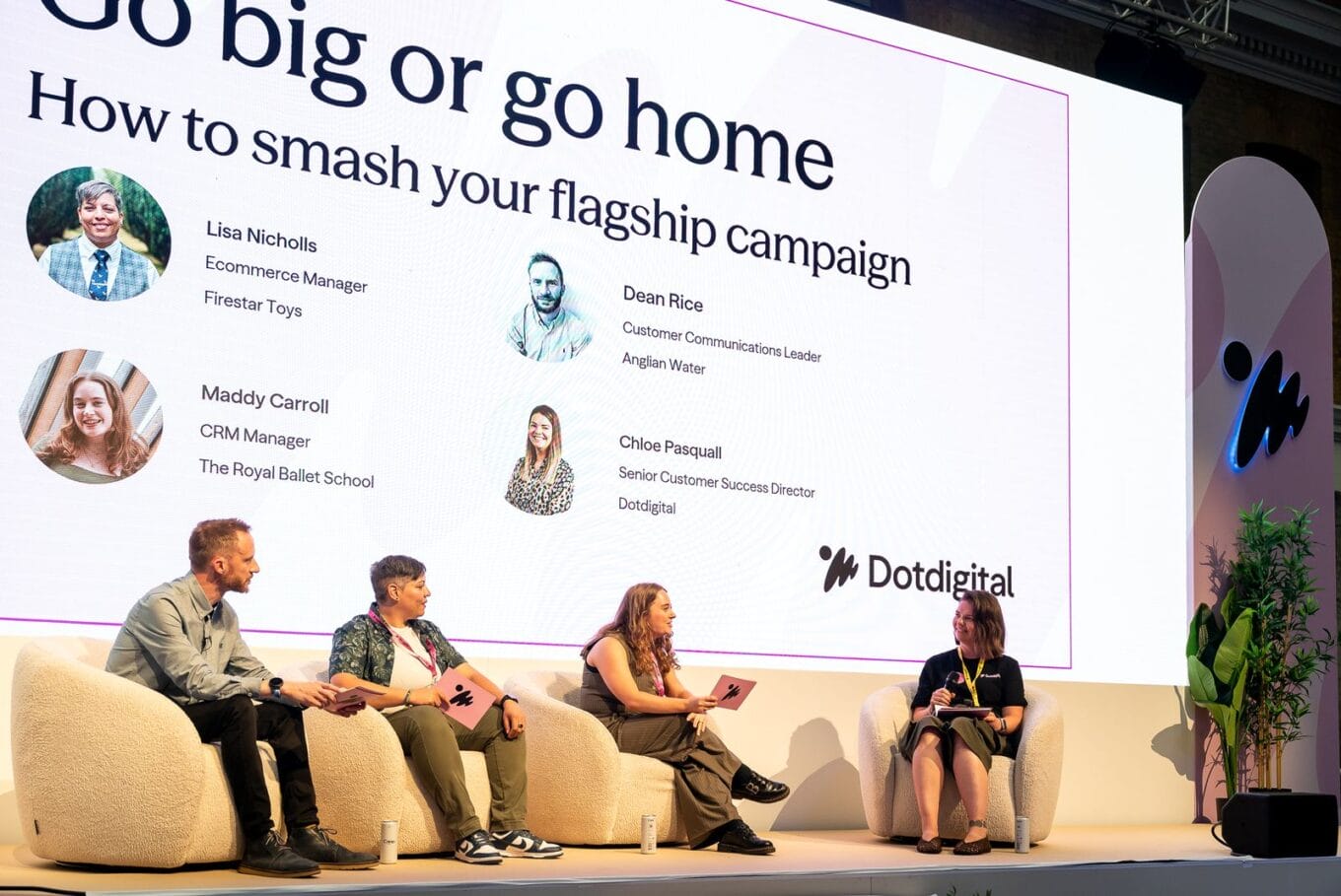
At the Dotdigital Summit, three marketers shared what happened when they were tasked with that kind of campaign.
- Maddy Carroll from The Royal Ballet School was part of a team marking 100 years of the school
- Lisa Nicholls from Firestar Toys was preparing for its biggest sales day of the year
- Dean Rice from Anglian Water was helping customers use less water as part of a nationwide smart meter rollout
Their campaigns couldn’t look more different, but the lessons behind them were similar: plan earlier than you think, make every part of the customer journey work together, and build systems that can handle whatever happens next.
Here’s what it took to pull each one off.
1. Plan your campaigns early
Big campaigns sometimes rely on teams, suppliers, technology, stock, data, and audiences all being ready at roughly the same time. The earlier you identify those dependencies, the more room you have to deal with them.
Build your audience as soon as you can
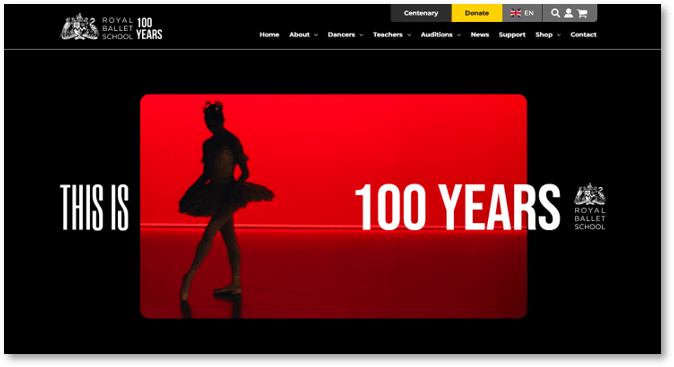
The Royal Ballet School turned 100 in 2026, and the campaign had been in the works for years before it launched at the end of 2025, with activity planned to run through 2027.
The campaign is built around ten key messages and includes public events the school has never run before. Those events are bringing entirely new audiences into the database, creating new audience-development work alongside everything else the team is managing. And they’re doing it with a small marketing team.
For CRM Manager Maddy Carroll, one of the challenges was making sure there was enough time to build those new audiences before the campaign got fully underway. Looking back, Maddy says she would have pushed harder to get the audience development work moving earlier, before other parts of the campaign started taking up the team’s time.
“I think I probably would have been a bit more firm about that,” she says.
The takeaway for marketers:
If your campaign is going to bring in new audiences, don’t leave audience development until the rest of the campaign is already moving. Work out what needs to happen to attract, capture, and onboard those audiences, then build those milestones into the campaign plan from the start.
Get everyone working to the same deadline
Firestar Toys’ big sales event of the year is May 4, leaning into Star Wars Day (May the Fourth be with you). The business can see seven to ten times its normal order volume in a single day, so there’s a lot to prepare for before the campaign goes live.
This year, the team extended the event from a long weekend into a full week, adding a gamified loyalty campaign alongside product drops. That loyalty layer is more than a nice extra: loyalty program members typically spend 67% more than non-members, so rewarding the customers who turn up for May 4 pays off well past the day itself.
And preparation was the responsibility of more than just the marketing team:
- Their third-party agency manages website development alongside other clients, so last-minute changes aren’t always possible
- Stock needs to be cleared and ready ahead of launch
- The website needs to be updated
- Customer support needs to know about new, restocked, and limited-edition products before customers start asking about them
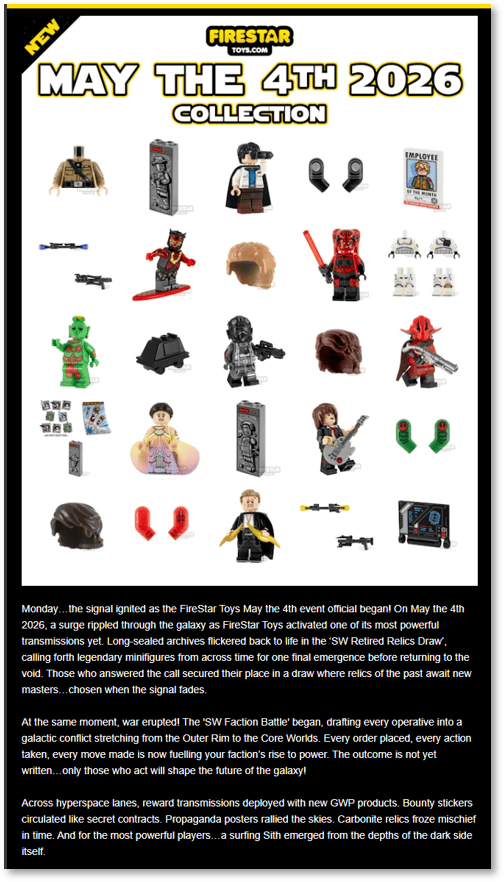
Then, when it comes to the messaging. Email, web, social, and customer support all need to be working from the same information, so people get a consistent experience wherever they interact with Firestar.
It’s why planning for the next May 4 starts almost as soon as the current one finishes. When you know a campaign is going to be busy, the preparation can’t sit with marketing alone. You need to work out what every team and supplier needs from you, and when they need it.
The takeaway for marketers:
Work backwards from launch and agree deadlines with every team, supplier, and partner whose work needs to be ready in plenty of time.
2. Make your flagship campaign work with everything else
A flagship campaign doesn’t replace your everyday marketing. You still have regular emails to send, automations running, and customers moving through different journeys. The challenge is making sure all of that still makes sense alongside the bigger campaign.
Bring your biggest campaign into your day-to-day marketing
At The Royal Ballet School, the centenary wasn’t treated as something that sat separately from the rest of the school’s marketing. It became part of the context for everything the team was sending.
Every business-as-usual (BAU) send was considered against the centenary, while people joining the database through the new public events were brought into existing automations.
The campaign also influenced how the school showed up visually, with its usual colors toned down in favor of black-and-white photography and the centenary logo carried across communications.
“Every send has to be considered in the context of the centenary,” Maddy says. “We’ve used Dotdigital to establish the centenary campaign as separate to our BAU campaigns, while still bringing it together in a really cohesive manner,”.
That doesn’t mean every email needs to become a centenary email. It’s about making sure the bigger campaign and your regular sends aren’t working against each other, or leaving customers wondering why they’re suddenly receiving something that feels disconnected from everything else.
The takeaway for marketers:
When you’re planning a major email campaign, look at your existing communications alongside it. Decide what should continue as normal, what needs to change, and where the two should connect. That way, the flagship campaign feels like part of the wider customer experience rather than something happening in isolation.
3. Get the customer journey in the right order
A customer can receive the right message at the wrong time. And many brands are already missing the mark here, with just 15% of consumers saying brand messages feel truly relevant to them.
When you’re running a complex campaign with multiple journeys happening alongside each other, getting the sequence right matters just as much as getting the message right.
Make sure every message arrives at the right time
Anglian Water’s smart meter campaign looks different from a typical marketing campaign. The goal wasn’t to sell more water. It was to help customers use less.
As a regulated monopoly, the company can’t win or lose customers through marketing. So, its smart meter rollout campaign was all about awareness and education, designed to help close a projected gap between water demand and supply by 2050. This was based on customer insights that found people underestimate their household water use by around 75%.
“The aim of our campaign is really to drive long-term sustainable behavior change,” Dean says.
With that goal in mind, the smart meter rollout involves three customer journeys that all need to happen in the right order.
- Pre-installation messaging needs to line up with when customers are due to have a smart meter installed, so they’re not being contacted about an installation before it is relevant to them
- Once a meter is installed, customers can also be introduced to tools that show how much water they’re using
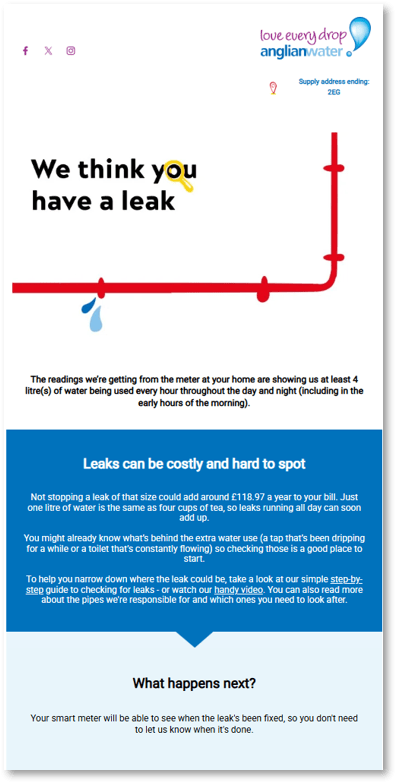
- Separate communications can alert them if their usage suggests they may have a leak
The leak alerts show why timing matters. If a customer’s usage suggests they have a leak, Anglian Water needs to tell them before they spot it themselves. Otherwise, they could log in to the usage portal, see a surprisingly high number, and worry about what’s gone wrong.
Reaching them first gives them context. They know what the number means and what to do next, so a worrying moment becomes a helpful one.
It’s a good example of why customer journeys can’t always be planned in isolation. Even a helpful tool can cause worry if a customer sees it without the right context first.
The takeaway for marketers:
Map out what a customer needs to know or do at each stage, and make sure your message reaches them before they find out another way.
4. Plan for what happens when the campaign works
A successful campaign can create just as many problems as a poorly performing one. If you’re expecting a significant spike in traffic, orders, or customer enquiries, the rest of the business needs to be ready to handle what the campaign generates.
Make sure the rest of the business can handle the demand
For Firestar Toys, months of preparation went into this year’s campaign. But when it went live, the response was bigger than expected, and the website couldn’t handle the amount of traffic it generated.
“Dotdigital did their job way too well,” Lisa says.
The campaign had done exactly what it was supposed to do. It sent customers to the website in such numbers that the site crashed.
For a team of three, it was a reminder that getting the campaign itself ready is only part of the job. The experience that follows needs to be ready too.
That means planning for what happens after the promotion, like:
- Can the website handle the traffic
- Is there enough stock?
- Does customer support know what customers are likely to ask?
- Can orders be processed if demand is much higher than usual?
- And if something does go wrong, who can fix it?
The takeaway for marketers:
Have a think about what happens after someone clicks. If a campaign is likely to create a rush in traffic or orders, bring the website, stock, customer support, and fulfillment teams into the conversation early. A few extra checks upfront can make a big difference when the campaign takes off.
5. Build systems that let small teams do big things
Our secret lives of marketers report found that the share of marketing teams with 10 or more people dropped from 10% to just 1% between 2025 and 2026, while the number of marketers working solo jumped from 21% to 38%.
The trick is deciding early which jobs need a person and which ones your systems can carry instead. All three brands are Dotdigital customers, and each ran its campaign with a relatively small team, so the systems behind the campaigns had to do some of the heavy lifting.
All three brands are Dotdigital customers, and each ran its campaign with a relatively small team. That meant the platform behind each campaign had to do some of the heavy lifting.
Build systems that don’t depend on one person
For The Royal Ballet School, the centenary campaign has been years in the making. That early work is now paying off in ways that outlast the campaign itself.
Maddy has spent years building The Royal Ballet School’s automations and CRM foundations. Because those systems are already in place, the day-to-day work can keep moving without everything depending on her being there.
She also made a point of training as many people as possible to use Dotdigital, so the know-how is shared across the whole team.
The takeaway for marketers:
If you’re working on a campaign that will run for months or years, build the foundations early and make sure more than one person knows how they work. That gives the team something to rely on when priorities change, people are busy, or the original campaign owner isn’t around.
Let automation handle the work
Firestar Toys has a marketing team of three, and for them, automation is part of how the team gets campaigns out.
“If there is something out there that can do the job for you, let it do it,” Lisa says.
Instead of manually managing every part of the customer journey, the team uses automation to handle the repeatable work, leaving them more time to focus on the parts that need a human decision.
The takeaway for marketers:
Look at the jobs your team repeats every campaign and ask which ones really need a person’s judgment. The more routine work you can hand over to your systems, the more time your team has for the decisions, ideas and problems that actually need them.
Connect your data to the customer journey
Anglian Water takes this a step further by connecting its smart meter systems directly to Dotdigital. When the data shows something that needs the customer’s attention, it can trigger a relevant communication without the team having to identify customers and send messages themselves.
For example, unusually high water usage can indicate a possible leak. An automated message can alert the customer to the issue and encourage them to investigate, helping them find and fix the problem sooner.
That gives the customer a useful next step while also freeing the team from having to manage every communication. It means they can spend more time testing and personalizing the customer experience.
Since 2020, those systems have helped customers find and fix over 700,000 leaks, saving an estimated 23 million liters of water a day.
The takeaway for marketers:
Connecting customer data to your communications can turn a change in someone’s behavior or circumstances into a timely, useful message. The technology is doing the repetitive work in the background, while the customer gets information when they can actually do something with it.
6. Leave room to adapt
The campaigns didn’t always go exactly to plan, and that’s OK. Things will come up that you can’t predict or control. And when they do, it helps to know you can change course without starting from scratch.
Be ready to change the plan
For Anglian Water, the global microchip shortage hit just as the smart meter rollout was starting to ramp up. With fewer meters available, the team had to shift its focus from encouraging new installations to engaging customers who already had meters.
The pandemic also changed the way the team communicated about installations. With engineers returning to customers’ homes after lockdowns, the messaging needed to acknowledge a very different situation for both customers and staff.
The original plan couldn’t continue unchanged. The team had to look at what was happening and adjust the campaign around it.
The takeaway for marketers:
A detailed plan gives everyone something to work from, but it shouldn’t stop you from responding when circumstances change. Build in room to adjust your messaging, timing, and priorities as you learn what’s happening on the ground.
What makes a flagship campaign work
The campaigns may have had very different goals, audiences, and challenges, but the same thing came through in all three stories: the work behind a big campaign matters just as much as the idea. A big campaign is so much more than the day itself, and the work, people, and tools behind it are incredibly important to its success.
- The Royal Ballet School showed the value of getting the foundations in place early and the importance of a big-picture approach
- Firestar Toys showed why the wider customer experience needs to be ready when a campaign takes off
- Anglian Water showed how much difference it can make when communications are built around what the customer needs to know, and when they need to know it
You can’t predict everything a big campaign will throw at you. But you can give your team the time, systems, and flexibility to deal with it when it does.
And sometimes, as Firestar Toys found, the biggest problem you have to solve is that your campaign worked a little too well.
