



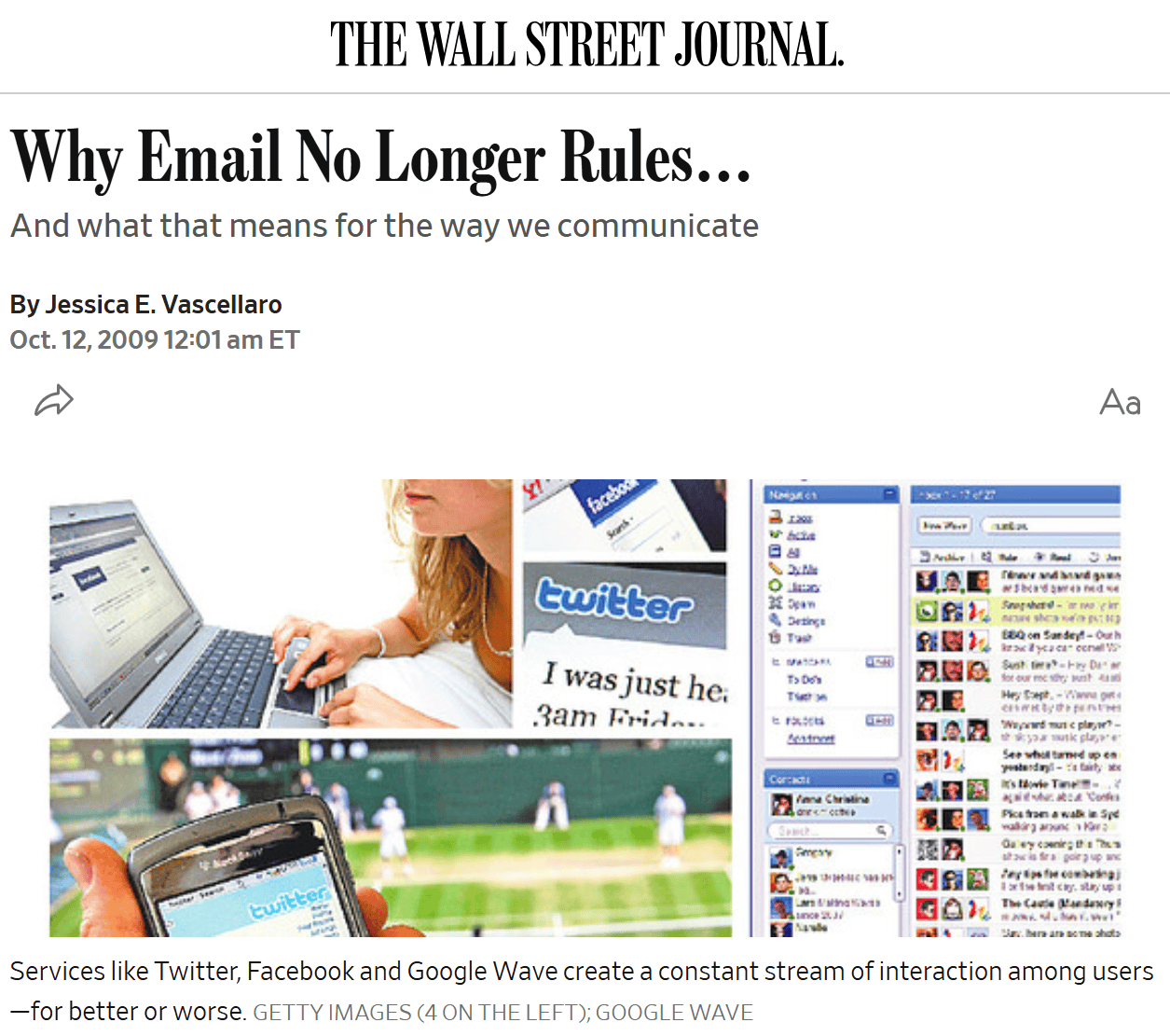
… or so they’ve been saying since 2009 (and probably even earlier). In 2009, The Wall Street Journal suggested that email’s reign was over. Seventeen years later, people are still predicting its demise. There are around 5,000 searches for “Is email marketing dead” every year, but the data tells a very different story!
Proof of life: the email stats you need to know
If email were on its last legs, you’d expect the numbers to tell a pretty bleak story. But the data paints a different picture.
- Email delivers ROI. When we asked 1,500 marketers which channel delivers the best ROI, email came out on top
- Consumers are happy to share their email addresses. When we asked 4,000 consumers which contact information they’re happiest to give to brands, email address was the most common answer
- Consumers love email. Email is consumers’ preferred way to hear from brands
- Email marketing is big business. Global email marketing revenue is projected to reach $14.5 billion by the end of 2026
- People are still engaging with emails. In 2026, Dotdigital’s Global Benchmark Report confirmed global email engagement benchmarks remain strong:
- Open rate: 55.4%
- Unique open rate: 37.3%
- Click-through rate: 3.7%
- Unique click-through rate: 1.4%
So if email delivers results, why does it sometimes feel like it’s not a marketing priority?
Is email punished for being steady?
When we asked those same marketers who ranked email top for ROI where email sat in their priorities, it came in ninth. Perhaps that’s because it’s an established channel that doesn’t need constant reinvention to keep delivering results. Compared with SEO, paid ads, and organic social, email can feel refreshingly steady.
That doesn’t mean email never changes. GDPR, Apple’s iOS privacy updates, and changes to inbox rules have all kept email marketers on their toes over recent years. But the fundamentals remain.
Why are other channels harder to keep up with?
Other marketing channels can demand a lot more time for learning, monitoring, and reacting to change. Google frequently updates its search algorithm, paid ad platforms regularly introduce new features, formats and pricing, and social platforms keep changing how content gets distributed.
These constant changes are the reason marketers are forever trying to understand why results can unexpectedly plummet, despite posting the same brilliant, tried-and-tested content that audiences love. And because communication about changes is often nonexistent, reassurance is sought by desperately scrolling LinkedIn and other marketing communities to see if it is a ‘you problem’ or an industry-wide issue.
What makes email’s consistency invaluable
Email doesn’t tend to change quite so dramatically overnight. And when regulations, inbox requirements, or email technology do change, marketers are not left to figure it all out alone. Changes are shared well in advance, and usually, your email platform (if it’s a good one) can help you adapt, create functionality that makes the updates for you, or at the least provide helpful advice to make sure you know what’s coming and how to respond.
Keeping up is taking its toll
In Dotdigital’s recent survey of 1,500 marketers:
- 1 in 4 said they struggle to keep up with new tools and ways of working
- 1 in 4 said they struggle with the pace at which the industry is changing
- Almost 1 in 5 (19%) said they’re at risk of burnout or are already burnt out
Email gives you something solid to build on, in a marketing world that rarely sits still.
What makes email so hard to replace?
There are a lot of reasons why email has stuck around for so long.
You’re in control
Email gives you, the marketer, a lot of control, especially when you compare it to social media or search marketing, where reach and algorithms can change, seemingly overnight, with no warning or explanation.
With email, you own your subscriber list and your strategy. You decide what goes into your emails, from the copy and imagery to the links and layout.
Of course, inbox providers like Gmail, Yahoo, and Outlook still have a say in whether your emails land in the inbox and how they render (that’s a conversation for another day), but largely it’s a flexible and fair channel.
You can make it personal
With the right data, you can tailor content to customers’ interests, preferences, and behavior, including features like countdown timers and scratch-to-reveal graphics.
Landing in someone’s inbox is much more direct and intimate than a public social post, or a billboard. You know who your email audience is, and have the opportunity to speak to their interests and behaviors, creating a memorable experience for the reader, and securing better results for you.
You can measure what matters
Clicks, sign-ups, revenue. Email gives you plenty of ways to understand how your campaigns are performing and where there’s room to improve. Attribution in marketing isn’t always straightforward, and one in four marketers say that communicating value to the wider business is a top problem for them.
We know from the Secret lives of marketers’ survey that email is the top channel for ROI according to marketers themselves. As an additional proof point here, we’ve even created a simple formula here to help you calculate the true value of every email address you collect.
The future of email: will people shift to messaging apps?
SMS, MMS, WhatsApp, and other mobile messaging channels have given marketers even more ways to reach customers. But do they mean email is on its way out? Absolutely not.
Different channels do different jobs. A mobile message can be brilliant for alerting customers to a flash sale or sending a timely reminder. Then email gives you more room to share a detailed update, showcase a collection, or send a newsletter with plenty of content.
You don’t need to choose between email and mobile messaging; you just need to know when to use each and how they can work together.
How do different generations feel about email marketing?
Speaking of new trends, our research suggests email still has a place across generations, although marketers don’t all prioritize it equally.
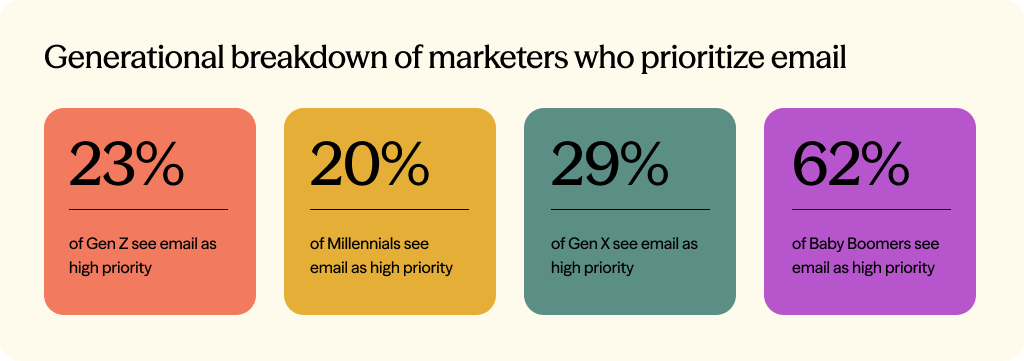
Marketers from the Baby Boomer generation are more than three times as likely to prioritize email as Millennial marketers:
Percentage of marketers who prioritize email, by generation:
- Gen Z: 23%
- Millennials: 20%
- Gen X: 29%
- Baby Boomers: 62%
So, what about email fatigue?
We’ve all heard that people’s inboxes are overflowing. And yes, nobody wants to receive a dozen irrelevant emails a day, but the good brands aren’t doing that – and haven’t been for many years.
Emails that are relevant, interesting, or full of things that make the readers’ lives better are a blessing, not a bother.
If your engagement metrics are showing signs of fatigue, it could be how you’re using email rather than the channel itself.
Think about your current marketing emails and ask yourself:
- Are they relevant? Do they reflect subscribers’ behavior, like what they’ve browsed, or personal details, like their location? And do they respect their preferences?
- Are they useful? Does each email give subscribers something worthwhile, whether that’s helpful information, a relevant offer, or a reason to come back?
- Are they arriving at a sensible frequency? Are you keeping in touch often enough to stay on subscribers’ radar, without overwhelming their inboxes?
Email fatigue is a reason to think more carefully about what you’re sending, who you’re sending it to, and how often. It’s not an argument that the channel itself has had its day.
The next big thing isn’t always the best thing
Marketing loves a shiny new thing. Remember when 3D TVs were going to change how we watched television at home? Or when NFTs seemed destined to become part of everything?
Predictions don’t always get it right. Some things we’re told will change everything never quite live up to the hype. Others, written off as failures, go on to become household names.
| The prediction | What actually happened |
|---|---|
| Email would be replaced by social media | Email is still a key marketing channel, and consumers continue to choose it as a way to hear from brands. |
| The metaverse would change how we live and work | The hype was huge, but we haven’t all moved into virtual offices and started shopping as avatars. |
| NFTs would change everything | The NFT market in 2024 was down 76% compared to its peak year in 2022 |
| Post-it Notes were a failed invention | Their adhesive wasn’t strong enough for its original purpose, but it turned out to be perfect for notes you can stick and remove. |
The same goes for marketing channels. It’s worth exploring new platforms and testing new approaches. You never know what might work brilliantly for your audience. But being new doesn’t automatically make something better, just as being established doesn’t mean something has stopped working.
What to do if your email is dead
If your email marketing isn’t delivering the results you want, ask why before writing the whole channel off.
Check:
- Are your emails reaching the right people?
- Is what you tell people to get them to subscribe matching what you’re then sending out?
- Is your content relevant to your audience?
- Are your subject lines giving people a reason to open?
- Are your calls to action clear?
- And are you looking at the right metrics to understand what’s working?
There could be plenty of opportunities to improve your strategy before you abandon the channel itself.
Email is not dead
Phew, thank goodness for that. Now, we know that new channels will come along and platforms will change their algorithms, introduce new features, and promise to completely change the way we market. Some will be worth the investment and others won’t.
For the last 30+ years, email has continued to give marketers a way to reach their audiences, build relationships, and make money.
So, by all means, try the new thing. Test, experiment, and grow – that’s non-negotiable; just don’t forget to give your tried-and-tested performers the attention they deserve in the process.
What 1,879 marketing emails can teach us
For more tips on what keeps email alive and kicking, check out this blog on the five things that stood out the most when we analyzed 1,879 emails!
