



A recent survey by Gartner discovered that marketing teams are using 33% of their marketing tech stack’s full capabilities. This has a direct impact on the success of your charity’s mission.
Beyond just marketing, technology has become a cornerstone of organizational success. It empowers your charity to operate effectively, engage stakeholders, volunteers, and fundraisers efficiently, and ultimately maximizes the impact of your cause.
The number of technology solutions available for charitable organizations has grown exponentially in recent years. Navigating the increasingly complex technological landscape is proving to be a significant challenge.
From marketing automation and fundraising platforms to CRMs and reporting tools, you have everything you need for success, but only if you use it efficiently. Sprawling, disconnected stacks are becoming the norm as teams proliferate technology solutions to meet their needs. A truly successful charity needs to create a streamlined and interconnected technology stack to reduce waste and improve impact.
Why is a streamlined charity tech stack important?
Before we begin, let’s look at what a tech stack is.
A technology stack (tech stack) is a collection of software solutions, programming languages, frameworks, and tools that work together to build digital applications (like apps or websites) and services.
For your charity, building a strong and efficient tech stack is essential for achieving your mission. A streamlined tech stack allows you to optimize your operations, improve inter-departmental productivity, and reach your mission-driven goals.
By carefully building your perfect charity tech stack, you will immediately enjoy a wide range of benefits, including:
- Improved efficiency: A well-designed tech stack empowers teams to automate or streamline repetitive tasks, allowing them to focus their resources on delivering mission-impacting services.
- Enhanced communication and collaboration: Facilitate effective communication among staff, volunteers, donors, and stakeholders using streamlined tech for a stronger community of employees and supporters.
- Expanded reach and impact: Unified tech stacks allow you to leverage digital marketing, social media, and fundraising platforms, resulting in the amplification of your message and mission.
Understanding your tech stack needs
Despite the numerous benefits of streamlining and modernizing tech stacks, charities face significant challenges in achieving this goal. Financial hurdles in particular disrupt your organization’s ability to invest in the right tech.
With that in mind, you need to have a clear understanding of your charity’s unique needs when purchasing new tech. Consider factors including:
- Your mission and services: What causes do you support? What services do you need to provide? What technology is going to help you achieve this?
- Donor and volunteer base: Who are your current and potential donors? Are they different from your volunteers? How do all these supporters prefer to engage?
- Team size and skillset: How many different teams make up your organization? What tech do they need to achieve their goals? What are their technical capabilities?
- Budget: How much can you realistically invest in all technology?
Essential components of a charity tech stack
Having a strong understanding of your needs will help you identify the right tools. Let’s take a look at the essential components you need to build the perfect tech stack.
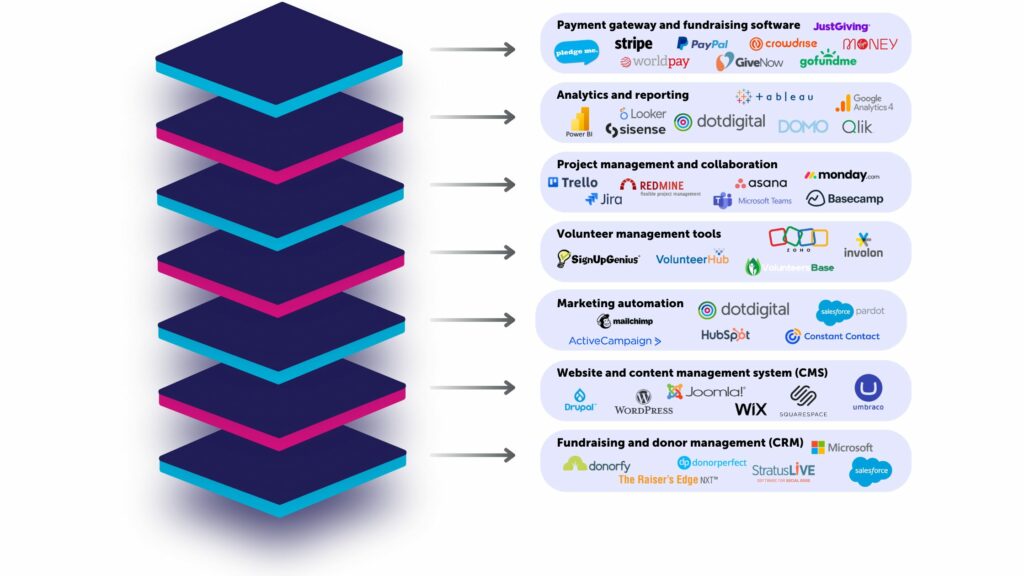
Fundraising and donor management (CRM)
A robust CRM like Salesforce, Donorfy, StratusLIVE, and Raiser’s Edge is crucial. It centralizes donor information, tracks interactions, and facilitates targeted communication for strong relationships.
Key features to look for include:
- Segmentation and donor profiling to enable target fundraising campaigns
- Integration with email marketing and fundraising platforms
- Recurring donation management
- Major donor management
- Event management capabilities
- Grant management
Website and content management system (CMS)
A user-friendly CMS like WordPress or Drupal allows you to make easy website updates and content creation, showcasing your mission and impact stories. Your CMS should help you create a clear and accessible online presence for your charity.
Key features of a strong CMS include:
- User-friendly interface for quick and easy updates
- Mobile site optimization
- Integration with donation platforms
- SEO capabilities
- Form integration
- Accessibility features
- Ecommerce functionality (for merchandise sales)
Marketing automation
Charity marketing teams often have to run with limited resources. That’s what makes marketing automation tools a vital and central part of your tech stack. Automation tools like Dotdigital help your marketing teams build email campaigns, send personalized messages to donors, and nurture leads. These platforms also provide valuable analytics to optimize campaigns.
Key features to look for:
- Email templates and personalization
- SMS template and personalization
- Automation workflows (e.g. welcome series, donation ‘thank you’ emails, volunteer onboarding)
- Testing
- Integrations, API, and webhooks
Volunteer management tools
Keeping volunteers engaged is vital and volunteer management tools can provide you with new, digital ways to stay connected. From building event registration forms to handling scheduling, volunteer management tools can help you streamline communication to stay connected with and retain your volunteers.
Tools like VolunteerMatch, SignUpGenius, and VolunteerHub include features including:
- Volunteer application and screening
- Shift scheduling and management
- Time tracking and reporting
- Volunteer recognition tools
Project management and collaboration
Cross-team collaboration empowers your charity to reach new heights. Using collaboration tools such as Asana, Basecamp, or Slack will help your internal teams, volunteers, and organization partners work together with increased productivity and streamlined project management.
Key features to consider in a project management tool:
- Task management and assignment
- File sharing and document management
- Communication tools (chat, video conferencing)
- Project timelines and milestones
Analytics and reporting
Analytics and reporting tools give charities the valuable ability to analyze data and use it to evaluate campaign performance and inform future decisions. Tools like GA4 or nonprofit-specific platforms like Fathom provide data insights on website traffic, marketing campaign performance, and donor engagement. This data can inform strategic decision-making.
Key features to look for:
- Website analytics
- Email marketing analytics
- Fundraising performance metrics
- Social media analytics
Payment gateway and fundraising software
Secure and reliable platforms like Paypal or Stripe enable safe online donations via your website or mobile app and fundraising software can boost fundraising efforts. The best payment tools provide donors with a smooth and secure donation experience and give your charity crucial data to serve their fundraising needs.
When selecting payment tools, consider:
- Integration with website and CRM
- Recurring payment options
- Mobile payment acceptance
- Fraud prevention
Top tips for building your charity tech stack
1. Integration is key
A disconnected tech stack leads to inefficiencies, siloes, and a lack of cross-team cohesion. Ensure your tools work together seamlessly to create a unified system. By breaking down data silos, you’ll gain a complete picture of your donors, volunteers, and operations, leading to more efficient workflows and informed decision-making. Additionally, a well-integrated tech stack can enhance the donor experience by providing a consistent and personalized journey across all touchpoints.
2. Open source vs. paid software
Weighing the pros and cons of open-source and paid software is essential. Open-source solutions (typically free and community-driven software) can be cost-effective, but they often require technical expertise for implementation and maintenance. On the other hand, paid software typically offers more features, support, and security, but comes with a price tag. Consider your organization’s technical capabilities and budget when making a choice.
3. Focus on user experience
Your perfect tech stack will empower, not frustrate. Ensure you’re choosing tools that are intuitive for both your staff and the people you serve. Look for AI features that will help streamline team efforts. A positive user experience will boost productivity, increase donor satisfaction, and strengthen volunteer engagement.
4. Prioritize scalability
Your charity will grow and evolve as you spread the word about your mission. Select technology that can grow and adapt to your changing needs. Features like webhooks and well-communicated roadmaps are vital to discover when purchasing new tech. Plus, a scalable tech stack will prevent costly overhauls and ensure your tools continue to support your mission as your organization expands.
Streamline your charity tech stack with Dotdigital
In the dynamic world of charity marketing, a fragmented tech stack can hinder your ability to maximize impact and achieve your mission. To truly connect with donors, volunteers, and supporters, you need a unified approach that brings together data, automation, and personalization.
Dotdigital offers a powerful solution. As a central hub for your marketing efforts, our platform integrates seamlessly with your existing tools to create a cohesive ecosystem. By streamlining your workflows, delivering targeted campaigns, and gaining deeper insights into donor behavior, you can build stronger relationships, increase fundraising efficiency, and drive meaningful change.
Let Dotdigital be your partner in creating a more impactful future for your charity.
